Broadband Solutions

Broadband Solutions, Custom Data Cables, Wireless Networks

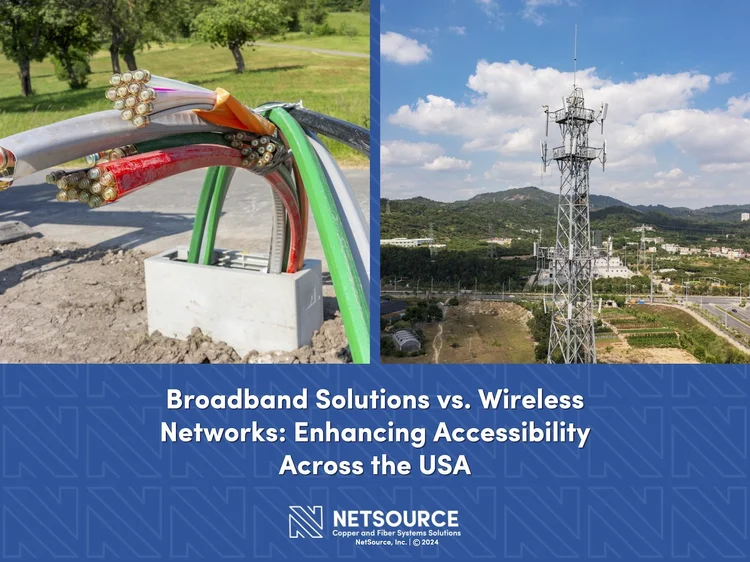
Broadband Solutions vs. Wireless Networks: Enhancing Accessibility Across the USA

Broadband Solutions vs. Wireless Networks: Enhancing Accessibility Across the USA By 2029, 98% of Americans will have access to the Internet, reflecting a significant stride toward nationwide digital connectivity. This surge in accessibility raises important questions about the comparative reach and efficiency of broadband and wireless networks. This article examines how each contributes to bridging the digital divide in diverse American regions. We compare the roles and accessibility of broadband solutions vs. wireless networks and highlight how innovative solutions from NetSource enhance internet accessibility across the USA. Clarifying Broadband Solutions vs. Wireless Networks: Are They the Same?  When you build a digital infrastructure, understanding the distinction between broadband solutions vs. wireless networks helps you deploy effective internet services. Broadband solutions encompass various high-speed internet technologies primarily delivered through wired connections such as DSL, fiber optic, and cable. These technologies provide stable and high-capacity connections. They create the backbone for internet services and large-scale data operations. unlike broadband solutions, wireless networks utilize technologies like Wi-Fi and fixed wireless access (FWA) to provide internet access without needing physical cabling. These wireless networks offer quick deployment and flexibility in geographic areas where traditional wiring is impractical. Accessibility of Broadband Solutions in the U.S. The accessibility of broadband solutions hinges significantly on the availability of advanced cabling solutions like custom fiber optic cables. Known for its reliability and high-speed capabilities, broadband is indispensable for supporting demanding applications. In fact, cable internet is available to nearly 90% of U.S. households. It has a widespread reach and extensive infrastructure already in place. However, the deployment of broadband infrastructure requires careful planning and significant investment. This is particularly seen in less urbanized areas where laying cables can be logistically challenging and economically demanding. Accessibility of Wireless Networks  Wireless network technologies, such as 5G and Wi-Fi 6, have redefined the accessibility of internet services. This impacts regions where laying physical cables is not feasible. In comparison to broadband solutions, wireless networks offer considerable advantages in terms of scalability and ease of expansion. Service providers can extend internet access to remote and underserved areas more rapidly. However, the level of access varies. In regions with strong wireless infrastructure, users can enjoy the high-speed benefits of a 5G network. Others might only have access to LTE. These networks, while flexible, face challenges related to signal interference and bandwidth limitations, particularly in densely populated or geographically complex areas. This creates the need for a strategic approach to placing antennas and repeaters to optimize signal strength and coverage. Broadband Solutions vs. Wireless Networks: Differences  Understanding these key differences and accessibility challenges between broadband solutions vs. wireless networks allows you to select the best technology and strategy for deploying internet services across geographic regions in the USA. At NetSource, we provide the foundational components you need. We have everything from cutting-edge telecommunications cables to custom network solutions that support both broadband solutions and wireless networks. We enable both to thrive and expand their reach. Leveraging Cable Manufacturer Technology: Broadband Solutions vs. Wireless Networks  Choosing the right type of connectivity can significantly impact your operational efficiency and business growth. With broadband solutions, your customers get high-speed data transmission that works for cloud computing, large-scale backups, and heavy data transactions. Whereas wireless network solutions have slightly slower data transmission speeds but offer incredible flexibility and reduced installation times. The Role of Custom Data Cables in Connectivity Across the USA Any reliable network requires an emphasis on quality cabling. At NetSource, we understand that effective connectivity requires seamless, uninterrupted service and the ability to scale efficiently. We craft our custom fiber optic cables and broadband infrastructure to address the unique demands of diverse business environments. With our custom data cables, you can support both broadband and wireless networks. Tailored Performance: The design of our custom small cell cables enhances signal quality and reduces latency. This is important for maintaining robust connections in dense urban settings or extensive corporate campuses. Enhanced Durability: Our custom fiber optic cables utilize high-quality materials and withstand environmental challenges. They provide long-term reliability and reduce the need for frequent replacements. Scalability Solutions: Our telecommunications cables adapt as your network needs increase. Whether expanding a current setup or integrating new technologies, our cables provide the backbone for future growth. Precision Design: We meticulously tailor each cable configuration to meet specific operational requirements. With our cables, you get optimal performance across various applications, from high-speed data centers to intricate telecommunications networks. By focusing on high-quality, custom data cable solutions, we help you meet current connectivity needs while also preparing you for future needs. With NetSource cables, you’re investing in a foundation that supports expansive growth and technological evolution. Partner With NetSource for Future-Ready Connectivity in the United States At NetSource, we provide you with connectivity solutions that propel your business forward. We help with both broadband and wireless networks’ roles tailored to ensure that your connectivity infrastructure is a strategic asset. Contact us today to explore how our broadband network solutions and innovative wireless setups can transform your business connectivity. We don’t just work to provide you with what you need today—we anticipate the technological demands of tomorrow


Broadband Expansion, (BEAD) Broadband Equity Access and Deployment, Broadband Solutions, Build America Buy America (BABA)

BEAD and BABA: Broadband Network Solutions for Rural Locations in the USA

BEAD and BABA: Broadband Network Solutions for Rural Locations in the USA The digital divide in the USA has significantly impacted rural communities, businesses, and educational institutions, creating a stark contrast between those with access to modern digital technologies and those without. This article explores NetSource’s provision of critical broadband network solutions that bridge this divide. Our commitment extends through the Broadband Equity, Access, and Deployment (BEAD) program and the Build America Buy America (BABA) Act. These aim to expand high-quality internet access and foster the benefits of broadband, ensuring no community is left behind in the digital age. Key Challenges to Broadband Expansion in the USA The expansion of broadband internet across the United States faces a series of interconnected challenges that hinder progress and contribute to the persistent digital divide. These challenges include: Costly Infrastructure Deploying broadband network solutions across the USA, especially in rural and remote areas, faces significant financial hurdles. The extensive costs stem from both the initial infrastructure setup and ongoing operations. Broadband providers often find it financially unappealing to extend services in areas with low population density, as the return on investment is not as immediate or significant compared to urban areas​​. Geographic Barriers The vast and often rugged terrain of the USA adds another layer of complexity to broadband expansion. Mountains, valleys, and extensive distances between rural communities pose physical and logistical challenges that complicate the laying of telecommunication cables. Such geographic hurdles increase the complexity and cost of projects, making it difficult to deliver reliable internet access to all regions​​. Technical Hurdles Choosing the right technology to serve different areas is a major technical challenge. Whether it’s fiber optic, fixed wireless, or satellite, each technology has its pros and cons depending on the area’s specifics. For instance, fiber offers high speeds and reliability but is costly and challenging to deploy in rural or hilly regions. On the other hand, technologies like fixed wireless and satellite can cover wider areas at lower costs. However, they might offer slower speeds and higher latencies​. Lack of Awareness A significant barrier to broadband expansion is the lack of awareness among consumers and businesses about the full benefits of broadband. Many are not fully informed about how business broadband solutions can improve educational opportunities, health services, and economic growth. This lack of awareness can lead to reduced demand, which in turn affects investment in broadband infrastructure​. How BEAD and BABA Address These Challenges The BEAD program and BABA Act tackle the multifaceted challenges hindering broadband expansion in the United States. They work together to provide funding, data-driven insights, and strategic guidance to bridge the digital divide. BEAD The BEAD program plays a crucial role in addressing broadband access challenges through substantial funding allocation. With $42.45 billion set aside, BEAD is instrumental in expanding high-speed Internet access by focusing on infrastructure deployment, particularly in unserved and underserved areas. These efforts focus on locations that lack access to baseline service speeds, defined as less than 25/3 Mbps for unserved areas and less than 100/20 Mbps for underserved areas. This funding supports a range of activities, including planning, capacity building in state offices, and coordination with local communities​ (NTIA)​. Importantly, every BEAD-funded infrastructure project, either directly funded or indirectly influenced, is required to adhere to the BABA provisions. This means incorporating BABA mandates into all aspects of the project, from the initial terms and conditions right through to the agreements with subcontractors and secondary recipients, as mandated by federal guidelines under 2 CFR § 184.4(b). At NetSource, we can significantly contribute to these BEAD projects by providing broadband network solutions using robust data center cables, accelerating the deployment process. With our optical telecommunications services, we ensure efficient and reliable broadband access. BABA BABA (Build America, Buy America Act): The Build America, Buy America Act is designed to prioritize the use of domestically produced materials in federally funded infrastructure projects. Unlike BEAD, which targets broadband expansion, BABA ensures that federal investments in infrastructure projects, including those related to broadband, support American manufacturing and labor by requiring the use of American-made iron, steel, manufactured products, and construction materials. This focus on domestic production supports economic growth and job creation within the United States. NetSource’s Comprehensive Broadband Network Solutions As the leading cable manufacturer in the USA, NetSource provides end-to-end broadband network solutions designed to meet the diverse needs of businesses, communities, and service providers across the United States. With a focus on quality, reliability, and innovation, NetSource’s comprehensive offerings address the complexities of modern connectivity. Broadband Network Solutions At NetSource, we pride ourselves on delivering high-quality, reliable broadband network solutions that cater to a variety of applications across different sectors. Our solutions ensure robust connectivity supporting current and future technological demands, enabling seamless digital experiences. Our broadband infrastructure provides unmatched speed and reliability, whether for commercial use, educational institutions, or healthcare facilities. Core Our core capabilities extend into critical network infrastructure,  emphasizing telecommunication cables. These components are fundamental in constructing a resilient network backbone that supports high data transmission and reduces latency. Our data center cables handle substantial data loads essential for cloud computing and large-scale virtual data storage. Meanwhile, our industrial cables ensure that voice, video, and data are transmitted efficiently and securely, making them ideal for expanding corporate and telecommunication networks. Wireless In the wireless domain, NetSource offers innovative solutions geared toward enhancing fixed wireless broadband deployment. Our wireless solutions are crafted to overcome geographical barriers and provide internet access in areas where traditional cabling is not feasible. This includes rural or remote locations where establishing physical cables is challenging and costly. By leveraging advanced wireless technologies, we extend broadband accessibility to help bridge the digital divide and foster connectivity in underserved communities. Toward a Fully Connected Tomorrow Significant progress is being made through BEAD and the BABA Act toward a more connected future in the USA. They are pivotal in extending high-speed internet to both the farthest corners and the dense urban centers of the country, envisioning a

Scroll to Top