Data Center Infrastructur

Data Center Cables, Data Center Infrastructur

Choosing the Right Data Center Cables for Your Next Upgrade

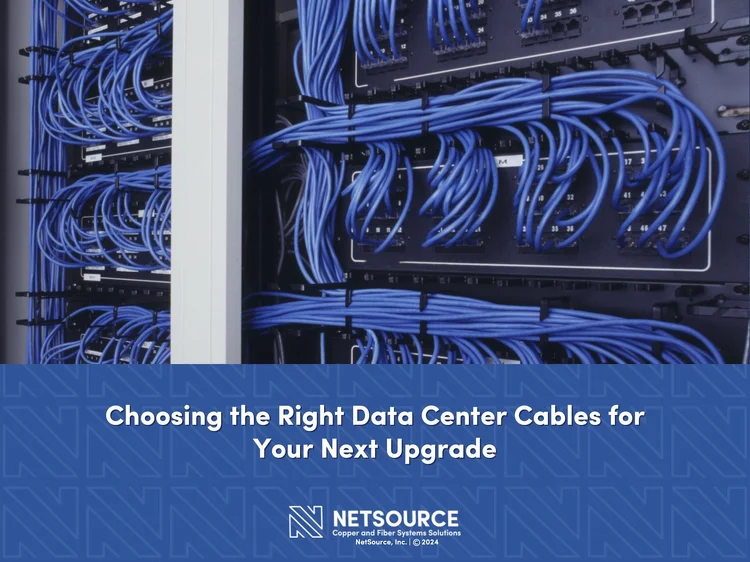
Choosing the Right Data Center Cables for Your Next Upgrade Moving, expanding, or upgrading a data center can be challenging. One of the biggest challenges is managing the complex network of data center cables. If cabling is not handled correctly, it can lead to downtime, poor performance, and unnecessary stress. This article will discuss the best practices for managing cabling during a data center move or expansion. We will also touch on the importance of choosing the right cables, labeling them correctly, and planning for future growth. At NetSource, we have been supporting businesses across the USA with these challenges for years, and we know how important it is to get it right. 1. Start With a Plan to Manage Data Center Cables Before doing anything else, you must have a solid plan for managing your data center cables. Every move or upgrade begins with assessing your current setup and determining the changes needed to support the new demands. Consider the type of cables you will use, whether they are MTP® cables for handling high data volumes or custom cable assemblies that suit your specific setup. Remember to plan for future growth, even if outside the immediate horizon. Like structured cabling, a scalable design is a smart choice because it allows for easy modifications later on. With structured cabling, everything stays organized, and you avoid the cluttered mess that could slow down operations or cause issues later. 2. Choose the Right Data Center Cables When dealing with data center cables, the cables you choose will play a significant role in your center’s performance. Communication cables are essential for data transfer and communication between systems. Still, it is not just about what cables to use—it is about matching the cables to your current and future needs. Custom cable assemblies can help you achieve a better fit for your unique setup. Working with custom cable assembly manufacturers ensures you are not left with one-size-fits-all solutions. Instead, you can get cables made specifically for your data center’s needs, improving efficiency and reducing unnecessary parts or lengths that could cause clutter. At NetSource, we have helped countless clients by providing tailored cabling solutions that perfectly fit their infrastructure. 3. Keep Cables Organized and Labeled It might seem obvious, but proper organization is paramount when managing data center cables. Poorly labeled cables can quickly become a hard-to-manage mess, especially when trying to make adjustments during a move or an expansion. If every cable looks the same and connections are unclear, you will lose valuable time trying to sort things out or make mistakes that bring down the network. To prevent these problems, label every data cable and port. Use clear, easy-to-understand labels that do not rely on technical jargon. In addition to labeling, make sure your cables are neatly bundled using cable ties, Velcro wraps, or trays. Good cable management also helps with airflow, which is crucial to prevent overheating in busy data centers. 4. Test and Validate Everything After you have installed all your data center cables, the next step is testing everything. You do not want something to go wrong to realize there is a problem. Testing ensures every cable assembly works as expected and your connections meet industry standards. At this stage, testing both copper and fiber cable assemblies is critical. Any weak spots need to be addressed before going live, saving time and money. At NetSource, we offer comprehensive testing services to ensure that every custom cable assembly meets the highest performance standards. Whether you are dealing with fiber optics or copper connections, our team can help ensure everything is ready to go. 5. Future-Proof Your Cabling Infrastructure With technology evolving so quickly, it is essential to think ahead. One of the most important parts of managing data center cables is ensuring that your system can handle future demands. For example, upgrading to MTP® cables can give you the capacity necessary for faster data transfers and higher bandwidth. Similarly, having scalable solutions allows you to grow your infrastructure without needing a complete overhaul later. Planning for the future may also involve choosing cables that meet the latest standards for speed and efficiency. Fiber optic cables are known for handling greater data loads than their copper counterparts. Ensure Success With a Solid Cabling Plan Managing data center cables during a move, expansion, or upgrade can be complex, but the right approach can make all the difference. By selecting the best cables, organizing them properly, and planning for future growth, you can ensure a seamless transition with minimal disruption to operations. At NetSource, we have the experience and products necessary to make your next project a success. From custom cable assembly to fiber optic solutions, we are ready to help you every step of the way. Reach out to NetSource today and let us assist you with your next data center project.
AI Systems, Data Center Infrastructur, Fiber Infrastructure

What AI Means for Data Center Infrastructure: Why Fiber Matters More Than Ever

What AI Means for Data Center Infrastructure: Why Fiber Matters More Than Ever AI is everywhere these days. If you’ve glanced at the news or skimmed a conference agenda, it’s the headline and the footnote. But for the people responsible for building and maintaining real infrastructure, AI isn’t an idea. It’s a set of pressures. That’s why at NetSource, we’ve been listening closely to the teams tasked with keeping ports lit, racks breathable, and upgrade paths open. Heavier workloads. Hotter racks. Denser port counts. And nonstop traffic between machines that now need to think faster, not just communicate. It’s not just about compute. AI’s real footprint lands in power, cooling, and physical pathways—especially the cabling infrastructure that ties everything together. Clients aren’t asking about AI roadmaps. They’re asking how to keep ports lit, racks breathable, and upgrade paths open. This post isn’t about the promise of AI. It’s about the very real changes happening inside the walls and ceilings of data centers trying to keep up. AI Doesn’t Float in the Cloud. It Bottlenecks in the Rack Let’s ground this. AI doesn’t just “run in the cloud.” It runs on silicon. And silicon lives in buildings full of cables. Generative AI, inference clusters, and training workloads have brought a new flavor of heat to the network layer. More GPUs mean more east-west traffic. More east-west traffic means higher aggregate bandwidth. And more bandwidth means more links. Or more efficient ones. This isn’t theoretical. Hyperscale sites are already shifting toward architectures that prioritize: Low-loss optical backbones High-density fiber trunks Greater port accessibility and modular cabling Even mid-market deployments are starting to mirror these concerns. The issue is no longer about peak speed. It’s about stackable, supportable, sustainable throughput that doesn’t eat up floor space or air capacity. Consider a typical AI refresh cycle for a regional co-location facility. New racks arrive with high-density GPU chassis that double east-west bandwidth needs overnight. Suddenly, what was a “well-designed” copper/fiber hybrid is now a liability. Patch fields are crowded, link budgets are fragile, and lead times on pre-terminated fiber trunks can’t keep up. These moments drive infrastructure leaders to rethink not just what they install, but how they plan for what’s next. It’s worth noting that the same challenges are creeping into enterprise deployments, too. As organizations adopt smaller-scale AI models, they’re discovering that their network layers weren’t designed for the volume of east-west traffic those models generate. Bandwidth demand isn’t just peaking. It’s pulsing in unpredictable cycles, putting strain on cable trays, switching fabric, and power distribution alike. Why Fiber Isn’t Just “Faster.” It’s Smarter Infrastructure Speed is only part of the story. The move to fiber in AI-sensitive environments is driven by a combination of physical and operational realities: Space efficiency: High-density MTP/MPO connectors reduce cable volume, free up airflow paths, and support easier access. Thermal performance: Fiber generates less heat and reduces airflow resistance. This is a key consideration in AI-accelerated zones where cooling is already maxed. EMI immunity: Fiber avoids the signal degradation and interference issues common in copper-heavy trays. Upgrade flexibility: Modular panel systems and scalable trunk designs simplify transitions from 10G to 40G to 100G and beyond. Fiber doesn’t just deliver performance. It extends the lifespan and modularity of the environment it lives in. And unlike copper, fiber doesn’t punish you later when density increases or roles shift. Teams who have made the switch to fiber-first architectures often report improved visibility, faster moves/adds/changes, and fewer post-deployment surprises. Not because fiber solves everything, but because it provides a cleaner baseline for evolution. Designing for What’s Coming, Not Just What’s Here Data centers rarely fail because of today’s traffic. They fail because of tomorrow’s expectations. Designing with fiber-first principles gives infrastructure teams breathing room. It allows planning for: Uncertain growth trajectories Shorter deployment windows Hybrid workloads with volatile bandwidth requirements Take a representative example. A mid-sized enterprise data center begins onboarding AI-enhanced video analytics platforms. The team doesn’t yet know how aggressively the workload will scale, but wants to avoid disruptive retrofits later. By shifting to a modular fiber architecture—with scalable trunks, labeled patch frames, and built-in slack capacity—they future-proof their space with minimal upfront cost. This is exactly the kind of planning NetSource supports. Our teams collaborate with integrators, contractors, and IT stakeholders to develop made-to-order fiber systems that match specific topology, timing, and termination preferences. And because everything is built and assembled in the U.S., timelines are predictable. We also see a growing number of clients using this moment to clean up legacy chaos. Moving from patchwork cabling to modular fiber systems reduces the risk of costly outages, speeds up troubleshooting, and makes it easier to train new team members on layout logic. When AI-driven platforms demand uptime, those day-to-day operational gains matter more than ever. What Fiber Enables in AI Deployments To summarize, fiber infrastructure doesn’t just “handle” AI. It enables it by making data center networks: Easier to cool Simpler to scale More resilient under load Quicker to reconfigure Cleaner to manage over time It turns a reactive scramble into a manageable system. That system becomes the backbone of innovation. Closing Thoughts: Don’t Build for the Buzz. Build for the Load. AI might be the acronym, but what it really brings is infrastructure stress. Fiber isn’t a futureproofing gimmick. It’s a practical response to the way networks are evolving. If you’re architecting systems that need to grow, flex, and perform under pressure, fiber deserves more than a line item. It deserves a conversation. And if you’re looking for that conversation, we’re ready when you are.

Scroll to Top