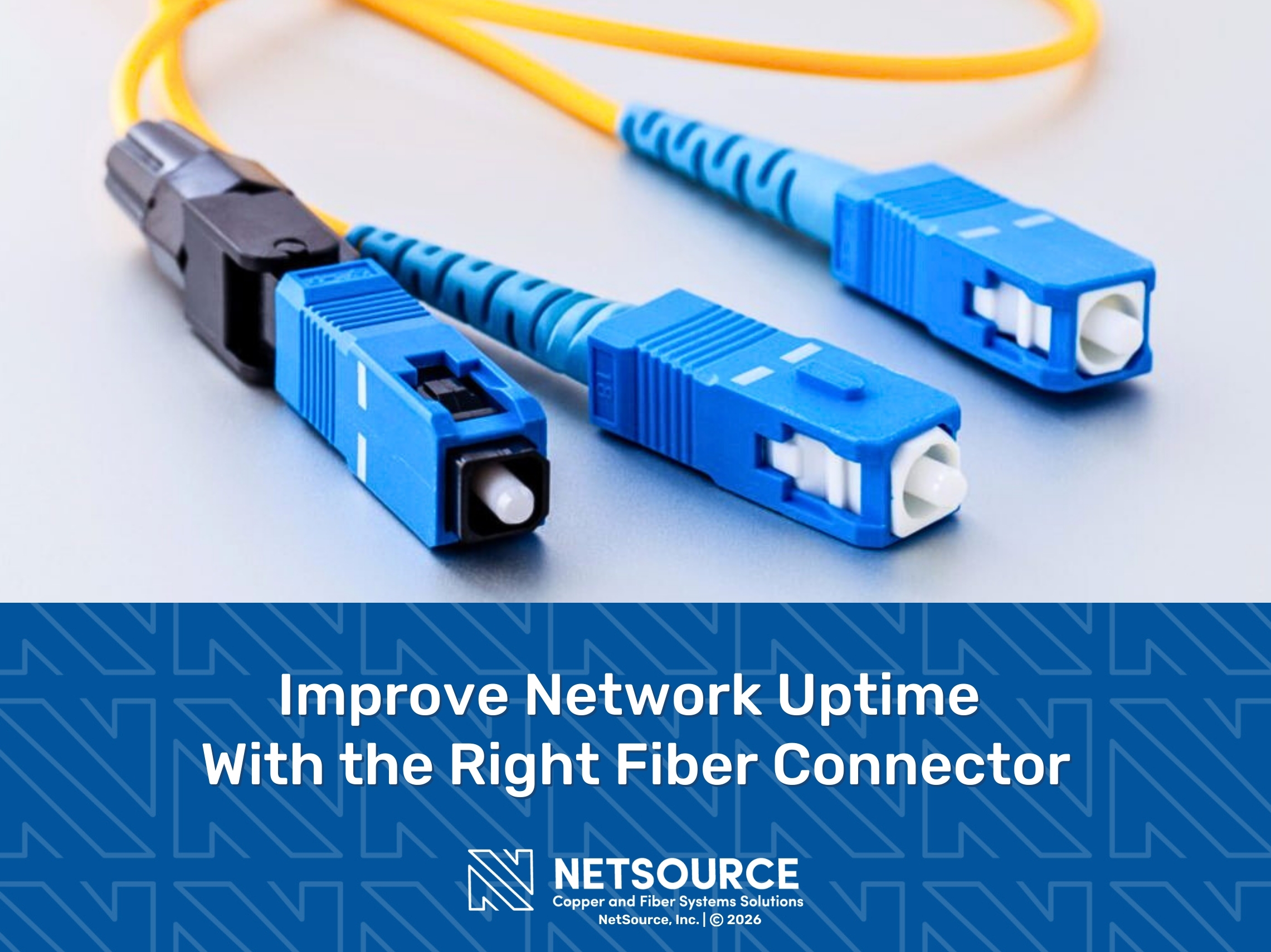
Fiber connectors are essential components in fiber optic networks. They join fiber optic cables together, allowing light signals to pass through with precision and minimal loss. Without the right connectors, network performance can degrade. This leads to data transmission issues with costly downtime.
Fiber connectors influence everything from signal clarity to the physical space within a network rack. They also play a key role in deployment speed and long-term maintenance. As a trusted cable manufacturer based in the USA, NetSource provides high-quality, custom-built fiber assemblies designed to meet your network’s specific needs.
Why Fiber Connector Types Matter for Network Efficiency
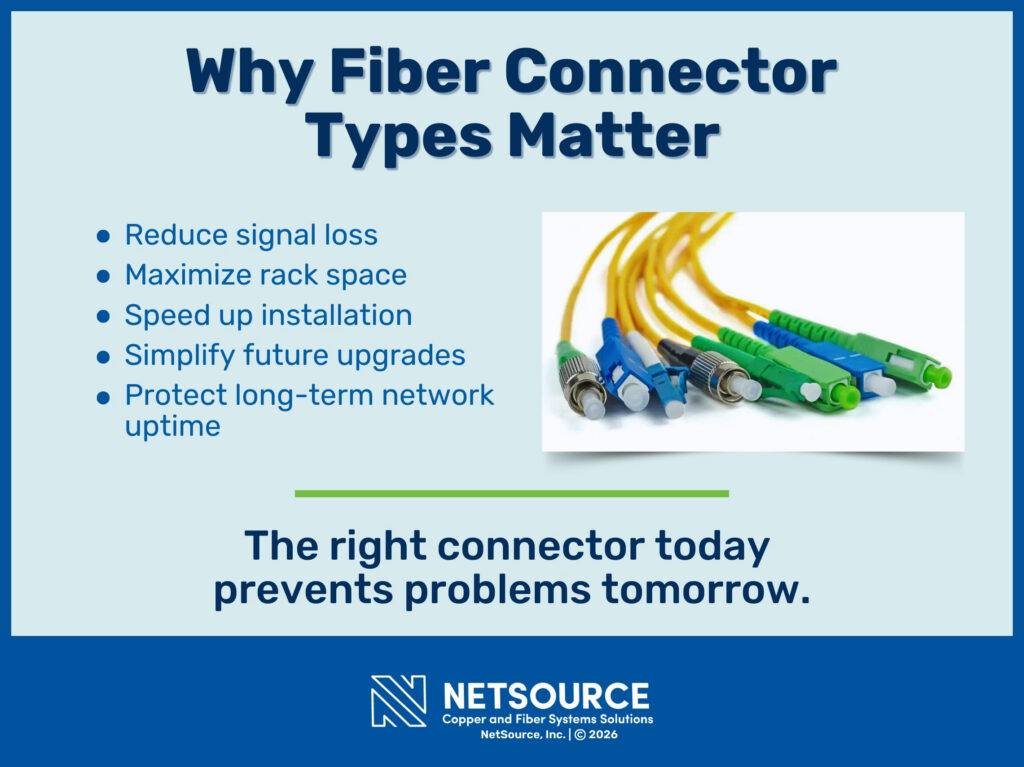
The type of fiber connector you choose can make a noticeable difference in how efficiently your network performs, how much space it uses, and how easily it can be scaled.
Here are the main factors impacted by connector selection:
- Signal Loss: Choosing a connector that aligns well with your fiber type helps reduce insertion and return loss, maintaining data integrity.
- Port Density: Smaller connectors, such as LC, enable more connections in a limited space, which is critical in compact or high-density setups.
- Installation Time: Certain connector types simplify installation and testing, speeding up deployment.
- Upgrade Paths: Scalable, high-density connectors make it easier to expand or reconfigure the network later.
By selecting the proper fiber connector from the start, you can minimize downtime, save on labor, and future-proof your infrastructure.
Common Fiber Connector Types
LC Fiber Connectors
- Size: 1.25mm ferrule (small form factor)
- Use Cases: Perfect for high-density environments such as data centers
- Modes: Compatible with both single-mode and multimode applications
SC Connectors
- Size: 2.5mm ferrule with push-pull design
- Use Cases: Common in telecom and enterprise networks
- Features: Durable, simple to connect and disconnect
ST Connectors
- Design: Bayonet-style with a 2.5mm ferrule
- Use Cases: Used in legacy LANs and industrial systems
- Features: Quick-connect design, though less common in modern networks
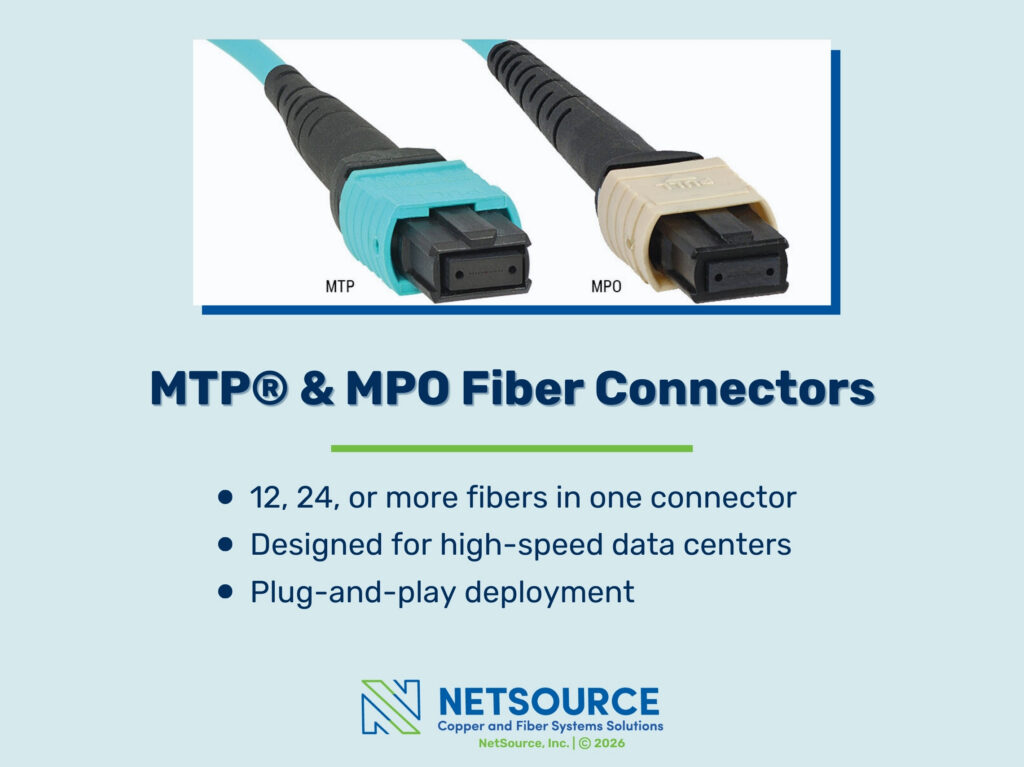
MTP® and MPO Connectors
- Fiber Count: 12, 24, or more fibers in one connector
- Use Cases: Best for high-speed, high-volume data networks
- Deployment: Fast, plug-and-play in data centers
- MTP®: Enhanced version of MPO with tighter tolerances and improved performance
Polish Types and What They Mean (APC, UPC, PC)
- APC (Angled Physical Contact): End-face polished at an 8-degree angle to reduce return loss; ideal for video and high-frequency data
- UPC (Ultra Physical Contact): Flat surface with tighter tolerances; provides low insertion loss
- PC (Physical Contact): Standard polish; suitable for general applications
The polish type affects signal quality, especially in high-bandwidth and long-distance scenarios.
Simplex vs. Duplex Fiber Connectors
- Simplex: Supports one-way data transmission, making it useful for one-directional communication setups
- Duplex: Enables simultaneous two-way transmission; standard for most network environments
Choosing between simplex and duplex depends on your system’s data flow requirements
Single-Mode vs. Multimode Connector Compatibility
- Single-Mode (9/125 µm): Used for long-distance communication and higher bandwidth
- Multimode (50/125 µm or 62.5/125 µm): Ideal for shorter distances and local area networks (LANs)
Not all connector types are suitable for both modes, so compatibility with your fiber type is critical.
Field-Terminated vs. Pre-Terminated Fiber Connectors
Field-terminated fiber connectors are installed directly on-site. This method gives technicians the flexibility to adapt and customize connections during installation. However, it requires skilled labor and can be time-consuming due to the precision and tools needed to ensure a clean, reliable connection.
Pre-terminated fiber connectors are assembled and tested at the factory before deployment. This option offers a faster, more efficient installation process with fewer chances for error. As a U.S.-based cable manufacturer, NetSource provides custom pre-terminated fiber assemblies tailored to your exact specifications. Thus, ensuring high performance and reduced field labor.
How Fiber Distribution Cabinets Support Scalable Network Infrastructure
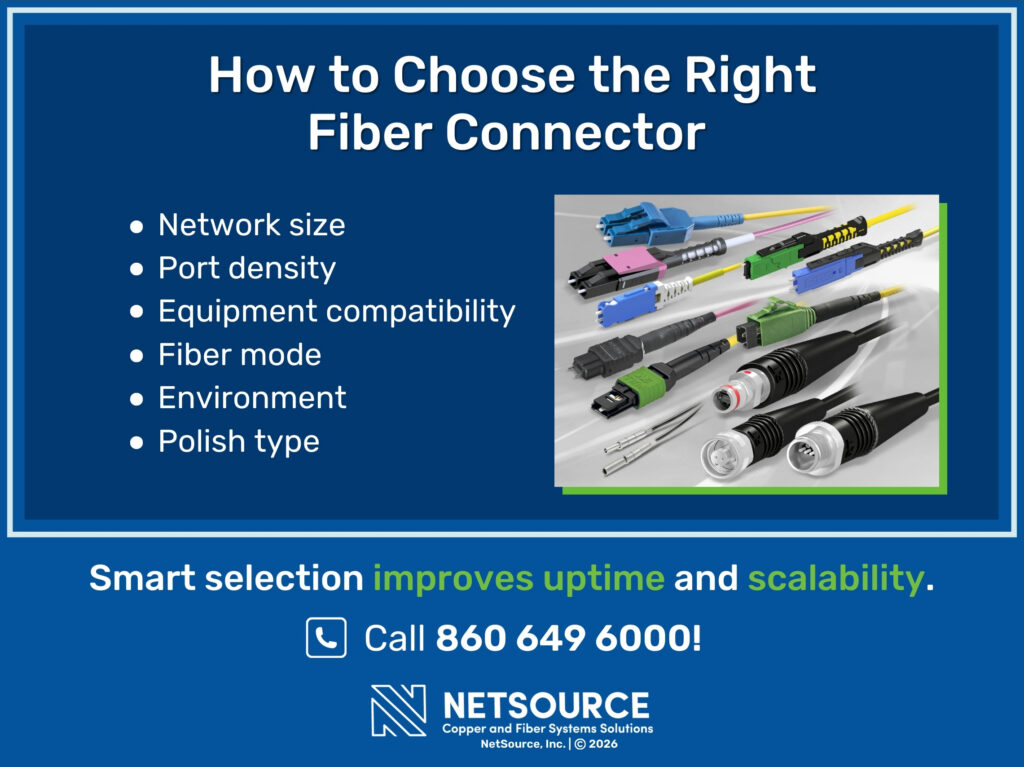
Choosing the Right Fiber Connector for Your Network
When selecting a fiber connector, consider:
| Factor | Recommendation |
| Network Size | Larger networks may benefit from high-density connectors like LC or MPO |
| Equipment Compatibility | Match connectors with ports on switches, routers, and panels |
| Connector Type | LC for density, SC for durability, MPO for multi-fiber deployment |
| Polish Type | APC for return loss-sensitive uses, UPC for general data transmission |
| Fiber Mode | Match connector to single-mode or multimode fiber used |
| Environment | Use weather-resistant or ruggedized connectors for outdoor or industrial installs |
Best Practices for Fiber Connector Installation and Maintenance
- Clean connector end-faces with lint-free wipes and alcohol
- Avoid excessive bending or tension on fiber cables
- Use proper cable management and strain relief techniques
- Regularly inspect connectors for dirt, damage, or misalignment
- Keep dust caps on unused connectors to prevent contamination
Why Work With a U.S.-Based Cable Manufacturer
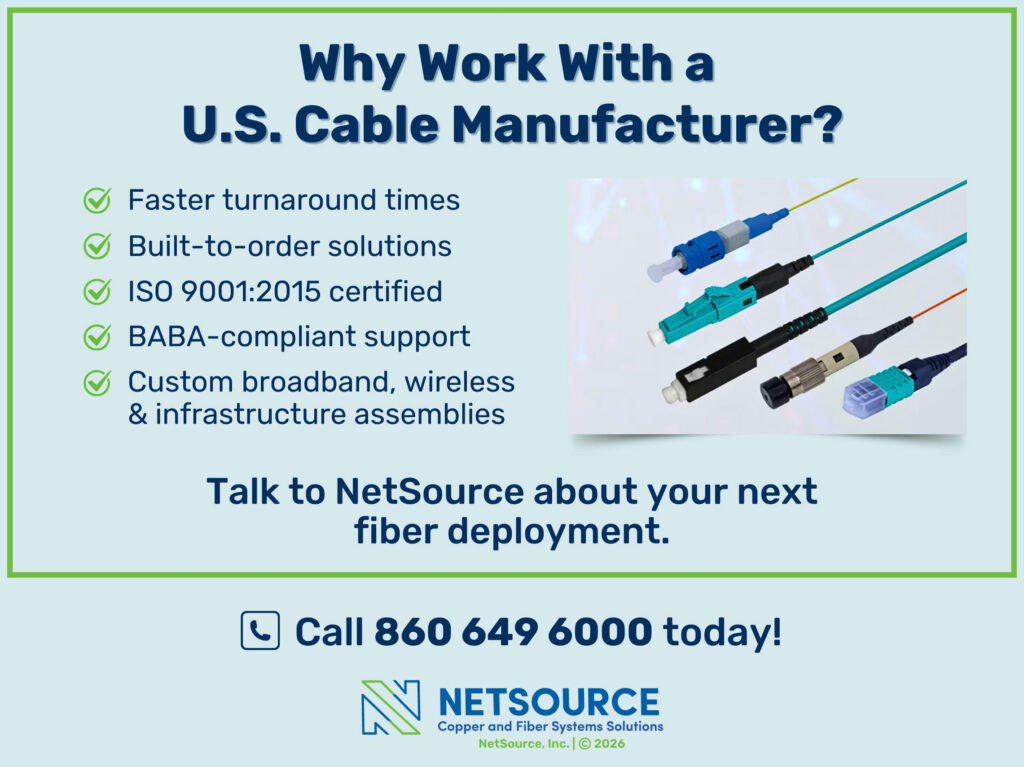
Working with a U.S.-based cable manufacturer offers several advantages that can make a tangible difference in both project delivery and long-term network performance. Faster turnaround times are possible thanks to domestic production, which helps reduce shipping delays and keeps projects on schedule. Compliance is another key benefit. NetSource fully supports BABA (Build America, Buy America) requirements, making it easier for clients to meet federal and government sourcing standards. Quality assurance is built into every product we manufacture, backed by ISO 9001:2015 certification that ensures consistent, high-performing components. NetSource offers highly customizable solutions across broadband, wireless, and infrastructure categories, allowing clients to receive products tailored precisely to their application needs.
Looking for technical specs? Download our fiber connector catalog to see detailed options.
FAQs About Fiber Connectors
- What’s the difference between LC and SC connectors?
LC connectors are smaller and ideal for dense patch panels, while SC connectors are larger and known for durability. - Can I mix multimode and single-mode connectors?
No. Mixing modes leads to signal loss. Always match the connector mode to the type of fiber cable. - How do I know which polish type I need?
Choose APC for applications requiring low return loss (such as video), and UPC for typical data transmission. - What is the most future-proof fiber connector type?
MTP®/MPO connectors offer scalability for high-bandwidth networks and are ideal for future growth. - What are SC and LC connectors?
SC connectors use a 2.5mm ferrule and feature a push-pull mechanism, making them reliable and easy to use in telecom environments. LC connectors with a smaller 1.25mm ferrule are better suited for high-density applications, such as data centers. Each serves different needs, and the right choice depends on your network’s design and space requirements.
Build Smarter, Faster Fiber Networks
The type of fiber connector you choose plays a critical role in your network’s speed, reliability, and future scalability. Whether you’re building a high-density data center or a long-distance telecom system, selecting the right connector can improve efficiency and reduce downtime.
NetSource will work with you to select and supply the best fiber connectors for your application.
Upgrade or optimize your fiber by contacting NetSource to select the right fiber connectors for your project. We’re here to ensure your deployment is efficient, reliable, and built to last.