Why Patch Panels Are Still Critical to Modern Networks
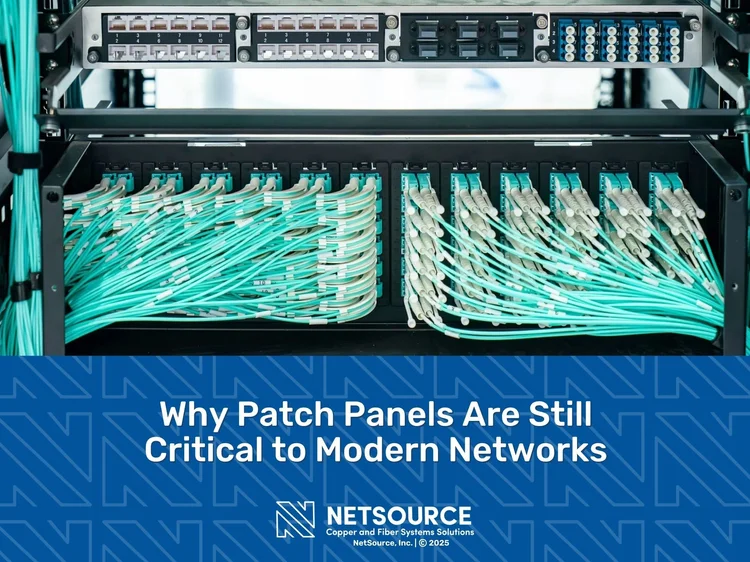
When building or upgrading modern networks, it’s easy to get caught up in headline technologies: 10G switches, fiber trunk cables, AI-ready infrastructure. One of the most essential components remains the humble patch panel. At NetSource, we manufacture and support a wide range of fiber patch panel options because, despite their low profile, they serve as a critical backbone for connectivity and future growth. The Function of a Patch Panel A fiber patch panel is a passive device that organizes and routes fiber optic cables. It allows technicians to connect incoming and outgoing lines without disrupting active service. In practice, this means faster troubleshooting, cleaner cable management, and far less risk of network downtime during moves, adds, or changes. This organizational role becomes even more important in high-density or mission-critical environments. Hyperscale data centers, for example, may need to manage thousands of fiber connections. A rack-mounted patch panel system ensures that each connection is labeled, accessible, and scalable. Modern Networks, Same Challenges Fiber technology has advanced rapidly—but cable management challenges haven’t disappeared. In fact, they’ve become more complex. Today’s installations often include: Mixed media (fiber + copper) Varied connector types (LC, MPO/MTP®, SC) Dense equipment bays with limited access A well-structured patch panel acts as a control point. It enables flexible port allocation, staged rollouts, and rapid equipment swaps—all without disturbing adjacent lines. This modularity is key to future-proofing any large-scale installation. Why Patch Panels Still Matter The need for organization and clarity only increases as modern networks scale. 1. Operational Efficiency Technicians can isolate and address issues without pulling or rerouting active cables. In high-pressure environments, that means lower risk and faster resolution. 2. Scalability Patch panels enable scaling in stages. New lines can be added cleanly without reworking the entire cabinet. This is crucial for hyperscale and enterprise facilities planning for rapid growth. 3. Structured Cabling Compliance Standards such as TIA-568 require organized cabling. Patch panels not only support compliance—they often determine whether a site passes inspection. How Patch Panels Evolve With Tech Patch panels may not make headlines, but they’ve kept pace with modern infrastructure. High-density units now support MTP®/MPO connectors, ribbon fiber, and speeds of 40G, 100G, or higher—without compromising on clarity or control. They allow infrastructure managers to maintain order even as data throughput accelerates. Hybrid environments that mix copper and fiber also benefit from updated panel designs. Angled and flat configurations support airflow and port accessibility, especially in crowded racks. These advancements keep patch panels relevant—not as legacy gear, but as future-ready infrastructure tools. Choosing the Right Patch Panel When selecting a fiber patch panel, decision makers need to evaluate the following: Connector types — LC, SC, MPO/MTP®: What are you standardizing on? Rack compatibility — 1U, 2U, or wall-mount? Fit matters for airflow and accessibility. Density requirements — How many ports do you need today, and how will that grow? Environment — Indoor cabinet, outdoor enclosure, or specialized housing? Panel design — Angled or flat for space and airflow? Color coding — Is it necessary for multi-tenant sites or facility zones? NetSource offers solutions for all of the above. From rack-mounted, high-density panels to rugged outdoor enclosures, our assemblies are built to specifications and backed by quick turnarounds. Supporting Tools and Add-Ons Patch panels don’t operate alone. Fiber cassettes, cable organizers, adapters, and blank plates contribute to an efficient layout. These accessories not only reduce strain and improve airflow, but they also protect the investment. Modular cassettes simplify installation and speed up MAC (Moves, Adds, Changes) work. Technicians spend less time on site and make fewer errors. NetSource offers a complete ecosystem of patching hardware to support performance, compliance, and technician ease of use. These are the same accessory standards trusted by data contractors and broadband providers across the U.S. in modern networks. Procurement & Customization Considerations Beyond selection, procurement strategy matters. Choosing the right vendor can mean the difference between a smooth rollout and supply headaches. NetSource supports a wide range of made-to-spec panel configurations—including labeling, color-coding, and pre-terminated assemblies. These enhancements reduce labor time and support faster deployment. For projects with aggressive timelines, our U.S.-based manufacturing means shorter lead times and more responsive communication—especially for enterprise or contractor clients managing multi-site builds. Real-World Impact While many of NetSource’s clients rely on patch panels for high-density environments, specific case studies remain confidential. However, patterns across deployments show measurable improvements in technician efficiency, shorter installation times, and reduced service disruptions when structured cabling systems are used correctly. Final Thoughts Even as networking trends evolve, the fundamentals remain the same. Organization and scalability matter for modern networks. And clean patching can make or break your infrastructure’s long-term reliability. NetSource is proud to help design and deliver fiber patch panel solutions tailored to the realities of modern network connectivity. If your team is planning a build or expansion, we’d love to be part of the conversation. Contact us or call 1-800-557-8818 to speak with a solutions expert.