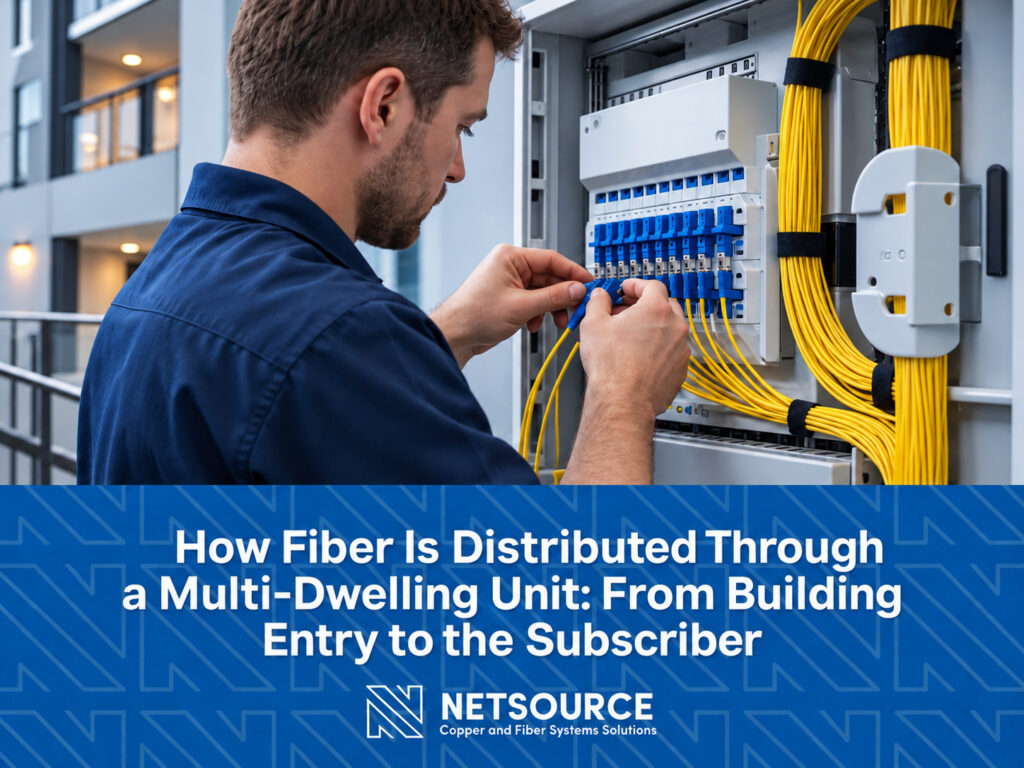
How Fiber Is Distributed Through a Multi-Dwelling Unit: From Building Entry to the Subscriber
Bringing fiber service to a multi-dwelling unit is only the beginning of the installation. Once the network reaches the property, fiber still has to move from the outside plant into the building, through shared distribution areas, vertically between floors, and eventually to an individual subscriber. Each transition introduces decisions about cable type, termination, splitting, enclosure placement, accessibility, and future expansion. Those decisions matter because apartment buildings, condominiums, mixed-use properties, and other MDUs rarely offer the clean pathways found in purpose-built data centers or telecom facilities. NetSource works with broadband providers and network designers on MDU fiber solutions ranging from building-entry enclosures and distribution hardware to pre-terminated trunks, pushable and pullable assemblies, and subscriber connectivity. Understanding how those pieces fit together is the first step toward designing an installation that can be deployed efficiently and maintained after the initial build. Think of MDU Fiber as a Series of Handoffs An MDU fiber installation is easier to understand when it is divided into the physical transitions the fiber makes through the property. In a typical building, those transitions include: Outside plant to inside plant at or near the building entrance Building distribution to the vertical riser system Riser fiber to floor-level or zone-level distribution Building infrastructure to the individual subscriber The exact architecture varies from property to property, but those handoffs recur. A high-rise apartment building may use a centralized distribution enclosure, vertical risers, and terminals serving individual floors. A smaller building may allow subscriber drops to run directly from a central location. Garden-style properties may require a different approach because multiple buildings or entrances may share a common distribution point. The best design is therefore not simply the one with the right fiber count. It is the one that accounts for how fiber physically moves through that particular property. Step 1: Bringing the Network Into the Building The first transition occurs where the outside-plant fiber reaches the MDU. This area commonly serves as the demarcation between the provider network and the building’s internal fiber infrastructure. Depending on the property, the transition may occur in an outdoor enclosure, building entrance facility, basement, telecommunications room, or utility area. This point has several jobs. The incoming fiber needs to be protected and organized. Outside plant cabling may need to transition to an indoor-rated cable. Splices, connectors, or optical splitters may also need to be housed in a location that technicians can reach later without disturbing unrelated infrastructure. Enclosure selection becomes important here because capacity is only one consideration. Installation environment, cable entry, splice management, connector configuration, security, and future access all influence the choice. NetSource offers MDU enclosures for this part of the network, including configurations that support patching, splicing, splitters, and transitions between outside plant and inside plant cabling. Step 2: Establishing the Building Distribution Point Once fiber enters the building, the next question is how the service will be distributed to the subscribers. Medium and larger MDUs commonly use a centralized distribution point in a basement, utility room, or other shared space. From there, fibers can be routed toward individual floors, zones, or units. This is where the architecture begins to affect future operations. A distribution point that is sized only for the first group of subscribers may be difficult to expand later. On the other hand, installing hardware for every theoretical future connection can add unnecessary cost and complexity. Designers, therefore, need to consider more than just the number of units in the building. They also need to consider expected take rates, splitter architecture, available pathway space, technician access, and how additional subscribers will be activated over time. A well-planned distribution point gives the network room to grow without turning every future connection into a reconstruction project. Step 3: Moving Fiber Between Floors Vertical distribution can be one of the more challenging parts of an MDU fiber installation. The building itself often dictates what is practical. Existing risers may already be crowded. Conduits can be small, discontinuous, or difficult to access. Historic buildings may offer few usable pathways, while newer construction may provide dedicated telecom spaces. There is no single cable strategy that fits all of those situations. Pre-terminated multi-fiber trunks can move large fiber counts efficiently between central distribution points and other areas of the building. Because connectors are installed and tested before the assembly reaches the jobsite, pre-terminated trunks can reduce the amount of field termination required during installation. Other projects may favor ruggedized bulk fiber followed by field splicing. For constrained pathways, pushable or pullable fiber assemblies can offer an alternative. NetSource offers compact assemblies using bend-insensitive single-mode fiber that can be routed through small pathways before the connector housing is completed at the installation end. The meaningful distinction is not simply pre-terminated versus field-terminated fiber. The better question is which installation method reduces field work while fitting the pathways the building actually provides. Step 4: Transitioning From the Riser to the Floor In larger buildings, fiber traveling vertically through the property eventually needs to branch toward subscribers. Floor-level terminals or intermediate distribution points provide that transition. Depending on the building layout and subscriber density, a terminal may serve a single floor, several adjacent floors, or a specific building zone. The riser fiber reaches that point, and smaller horizontal runs continue toward individual units. This transition deserves attention during design because it affects both installation and maintenance. Placing all connections at one distant central location can increase horizontal cable runs and make troubleshooting cumbersome. Adding too many intermediate locations increases the amount of hardware to manage. The right balance depends on the building. Good MDU fiber design, therefore, considers technician access as part of the architecture. A network still needs to be understandable several years after construction, when someone arrives to activate a new subscriber or diagnose a connection they did not originally install. Step 5: Reaching the Subscriber The final section of the network connects shared building infrastructure to the living unit or individual premise. In larger MDUs, horizontal drop cables may run from a floor-level