LC Fiber Connectors

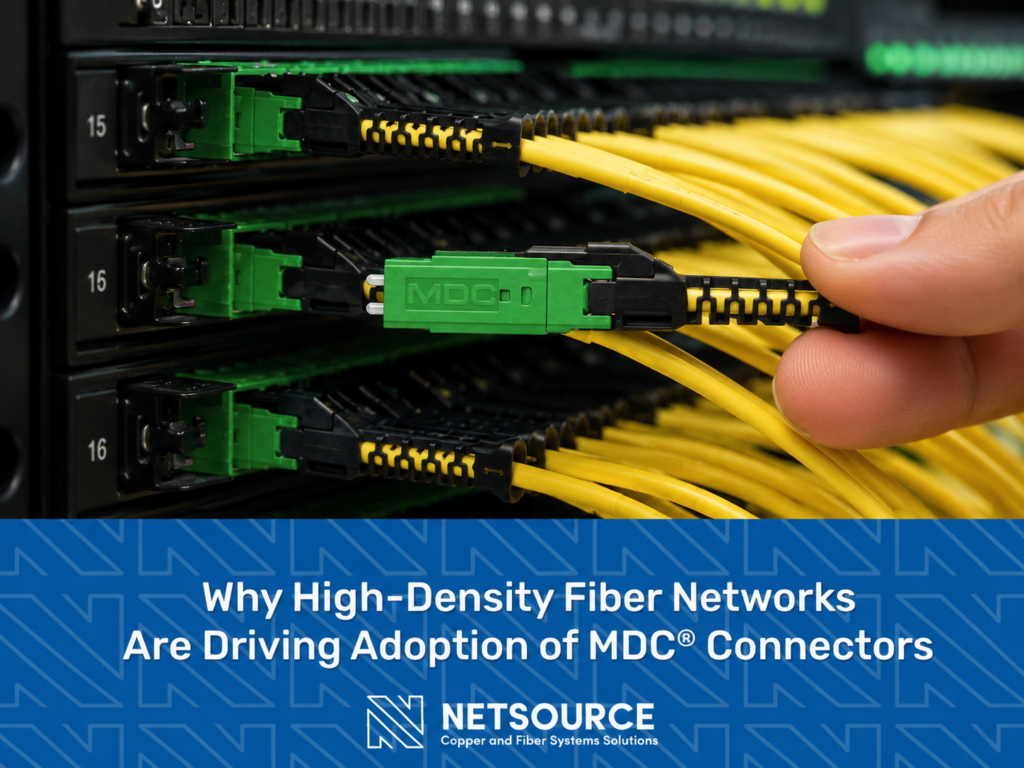
Closeup of tech inserting a MDC fiber connector into a high density patch panel. Why High-Density Fiber Networks Are Driving Adoption of MDC Connectors.
Fiber Infrastructure, High-Density Fiber Networks, LC Fiber Connectors, MDC connector

Why High-Density Fiber Networks Are Driving Adoption of MDC® Connectors

For years, the LC connector has been the standard for duplex fiber connectivity. It’s proven, widely adopted, and familiar to network designers across enterprise networks, telecommunications, and data center environments. So why are manufacturers, infrastructure providers, and network operators investing in a new connector platform? The answer isn’t simply higher bandwidth. It’s the growing need to increase connection density without continually expanding the network’s physical footprint. As compute environments become denser and applications such as cloud computing, AI, and hyperscale data centers continue to grow, operators are looking for ways to support more fiber connections within the same amount of rack and panel space. That’s where the MDC® connector, a registered trademark of US Conec, enters the conversation. The Challenge Isn’t Always Capacity When organizations begin planning network upgrades, discussions naturally focus on speed, throughput, and bandwidth. Those are important considerations, but they aren’t always the first limitation operators encounter. In many modern environments, physical density becomes the constraint long before bandwidth does. Patch panels fill. Rack space disappears. Expansion projects require additional cabinets simply because there is no room left to terminate additional connections efficiently. The cost of managing physical density can eventually become just as significant as expanding network capacity itself. This is particularly true in hyperscale data centers, cloud environments, AI infrastructure, and other applications where connection counts continue increasing year after year.   Why the MDC® Connector Was Developed The industry has introduced new connector platforms before, but successful adoption depends on more than creating a smaller connector. New connectivity solutions need to integrate into existing infrastructure, support evolving transceiver technologies, and deliver reliable optical performance while solving a real deployment challenge. The MDC® connector addresses one of today’s most common infrastructure challenges: maximizing fiber density without increasing the network’s physical footprint. Using industry-standard 1.25 mm ferrules, the MDC platform supports up to three times the connector density of traditional LC connectors within the same panel footprint. For organizations managing increasingly dense fiber environments, that additional capacity can help delay costly infrastructure expansion while making better use of existing rack space. MDC® and LC: Different Tools for Different Applications One misconception surrounding newer connector technologies is that they are intended to replace existing standards. That’s not really what’s happening here. The LC connector remains an excellent solution for many structured cabling systems and enterprise environments. It remains one of the most common duplex connector formats in production networks today. The MDC® connector addresses a different design challenge. When physical density becomes the limiting factor, a smaller connector footprint offers network designers another option to increase connection counts without fundamentally changing the surrounding infrastructure. Rather than replacing LC, MDC expands the design toolbox available to engineers planning next-generation fiber deployments. Integrating MDC® with Existing Fiber Infrastructure Adopting MDC doesn’t mean replacing an existing fiber plant. Most organizations will continue using a combination of connector platforms based on the needs of each portion of the network. LC connectors remain appropriate for many applications, while MPO/MTP® connectivity continues serving high-fiber-count backbone and trunk applications. The MDC® connector fits naturally between these established technologies by providing higher-density duplex connectivity where rack space and patch panel capacity have become operational constraints. For many organizations, migration is incremental rather than disruptive. New deployments can incorporate MDC, where higher density provides measurable value, while existing LC and MPO/MTP infrastructure continues supporting the broader network.   Where MDC® Connectors Make the Most Sense The MDC platform is particularly well-suited for environments where increasing connection density directly improves infrastructure utilization. Common examples include: High-density patch panels Hyperscale data centers AI infrastructure Cloud computing facilities Carrier and distribution networks Enterprise environments supporting 10G and 40G connectivity Modern 100G deployments Emerging 400G and 800G+ optical architectures The benefit isn’t simply supporting higher transmission speeds. It’s enabling more efficient use of available physical infrastructure as network demands continue to grow. Density Impacts More Than Space Discussions about connector density often focus on connection counts. The operational impact is usually more significant. As infrastructure becomes more crowded, routine maintenance becomes more difficult. Cable management becomes more complex. Moves, adds, and changes require additional planning. Troubleshooting takes longer because technicians have less room to work within densely populated panels. Higher-density connector platforms help address these operational realities by improving space utilization while maintaining organized, serviceable infrastructure. For many organizations, that’s just as valuable as adding additional ports.   Looking Ahead Network infrastructure continues to evolve alongside the growing demand for cloud services, AI workloads, and increasingly connected environments. Connector technology is evolving with it. The MDC® connector represents a practical response to one of today’s most common infrastructure challenges: supporting more connectivity without continually expanding physical infrastructure. As organizations begin evaluating higher-density fiber architectures, connector selection becomes part of a broader infrastructure strategy rather than simply a component decision. NetSource is expanding its connectivity portfolio with MDC-based custom fiber assemblies designed to support modern network environments. Beyond manufacturing assemblies, NetSource works with customers to evaluate connector platforms, assist with migration planning, develop custom fiber solutions, and help identify the right connectivity approach for each application. Whether planning a new deployment or preparing for future growth, understanding how connector density influences long-term infrastructure scalability is becoming an increasingly important part of modern network design. Call NetSource or contact us online to schedule a time to discuss your project requirements with a member of our team. 

Three blue fiber connectors attached to yellow cables. Article title.
Fiber Connector, LC Fiber Connectors, MPO/MTP® Connectors, SC & ST Connectors

Improve Network Uptime With the Right Fiber Connector

Fiber connectors are essential components in fiber optic networks. They join fiber optic cables together, allowing light signals to pass through with precision and minimal loss. Without the right connectors, network performance can degrade. This leads to data transmission issues with costly downtime. Fiber connectors influence everything from signal clarity to the physical space within a network rack. They also play a key role in deployment speed and long-term maintenance. As a trusted cable manufacturer based in the USA, NetSource provides high-quality, custom-built fiber assemblies designed to meet your network’s specific needs.   Why Fiber Connector Types Matter for Network Efficiency The type of fiber connector you choose can make a noticeable difference in how efficiently your network performs, how much space it uses, and how easily it can be scaled. Here are the main factors impacted by connector selection: Signal Loss: Choosing a connector that aligns well with your fiber type helps reduce insertion and return loss, maintaining data integrity. Port Density: Smaller connectors, such as LC, enable more connections in a limited space, which is critical in compact or high-density setups. Installation Time: Certain connector types simplify installation and testing, speeding up deployment. Upgrade Paths: Scalable, high-density connectors make it easier to expand or reconfigure the network later. By selecting the proper fiber connector from the start, you can minimize downtime, save on labor, and future-proof your infrastructure.      Common Fiber Connector Types  LC Fiber Connectors Size: 1.25mm ferrule (small form factor) Use Cases: Perfect for high-density environments such as data centers Modes: Compatible with both single-mode and multimode applications SC Connectors Size: 2.5mm ferrule with push-pull design Use Cases: Common in telecom and enterprise networks Features: Durable, simple to connect and disconnect ST Connectors Design: Bayonet-style with a 2.5mm ferrule Use Cases: Used in legacy LANs and industrial systems Features: Quick-connect design, though less common in modern networks MTP® and MPO Connectors Fiber Count: 12, 24, or more fibers in one connector Use Cases: Best for high-speed, high-volume data networks Deployment: Fast, plug-and-play in data centers MTP®: Enhanced version of MPO with tighter tolerances and improved performance Polish Types and What They Mean (APC, UPC, PC) APC (Angled Physical Contact): End-face polished at an 8-degree angle to reduce return loss; ideal for video and high-frequency data UPC (Ultra Physical Contact): Flat surface with tighter tolerances; provides low insertion loss PC (Physical Contact): Standard polish; suitable for general applications The polish type affects signal quality, especially in high-bandwidth and long-distance scenarios.   Simplex vs. Duplex Fiber Connectors Simplex: Supports one-way data transmission, making it useful for one-directional communication setups Duplex: Enables simultaneous two-way transmission; standard for most network environments Choosing between simplex and duplex depends on your system’s data flow requirements Single-Mode vs. Multimode Connector Compatibility Single-Mode (9/125 µm): Used for long-distance communication and higher bandwidth Multimode (50/125 µm or 62.5/125 µm): Ideal for shorter distances and local area networks (LANs) Not all connector types are suitable for both modes, so compatibility with your fiber type is critical. Field-Terminated vs. Pre-Terminated Fiber Connectors Field-terminated fiber connectors are installed directly on-site. This method gives technicians the flexibility to adapt and customize connections during installation. However, it requires skilled labor and can be time-consuming due to the precision and tools needed to ensure a clean, reliable connection. Pre-terminated fiber connectors are assembled and tested at the factory before deployment. This option offers a faster, more efficient installation process with fewer chances for error. As a U.S.-based cable manufacturer, NetSource provides custom pre-terminated fiber assemblies tailored to your exact specifications. Thus, ensuring high performance and reduced field labor.   How Fiber Distribution Cabinets Support Scalable Network Infrastructure Choosing the Right Fiber Connector for Your Network When selecting a fiber connector, consider: Factor Recommendation Network Size Larger networks may benefit from high-density connectors like LC or MPO Equipment Compatibility Match connectors with ports on switches, routers, and panels Connector Type LC for density, SC for durability, MPO for multi-fiber deployment Polish Type APC for return loss-sensitive uses, UPC for general data transmission Fiber Mode Match connector to single-mode or multimode fiber used Environment Use weather-resistant or ruggedized connectors for outdoor or industrial installs Best Practices for Fiber Connector Installation and Maintenance Clean connector end-faces with lint-free wipes and alcohol Avoid excessive bending or tension on fiber cables Use proper cable management and strain relief techniques Regularly inspect connectors for dirt, damage, or misalignment Keep dust caps on unused connectors to prevent contamination Why Work With a U.S.-Based Cable Manufacturer Working with a U.S.-based cable manufacturer offers several advantages that can make a tangible difference in both project delivery and long-term network performance. Faster turnaround times are possible thanks to domestic production, which helps reduce shipping delays and keeps projects on schedule. Compliance is another key benefit. NetSource fully supports BABA (Build America, Buy America) requirements, making it easier for clients to meet federal and government sourcing standards. Quality assurance is built into every product we manufacture, backed by ISO 9001:2015 certification that ensures consistent, high-performing components. NetSource offers highly customizable solutions across broadband, wireless, and infrastructure categories, allowing clients to receive products tailored precisely to their application needs. Looking for technical specs? Download our fiber connector catalog to see detailed options.   FAQs About Fiber Connectors What’s the difference between LC and SC connectors? LC connectors are smaller and ideal for dense patch panels, while SC connectors are larger and known for durability. Can I mix multimode and single-mode connectors? No. Mixing modes leads to signal loss. Always match the connector mode to the type of fiber cable. How do I know which polish type I need? Choose APC for applications requiring low return loss (such as video), and UPC for typical data transmission. What is the most future-proof fiber connector type? MTP®/MPO connectors offer scalability for high-bandwidth networks and are ideal for future growth. What are SC and LC connectors? SC connectors use a 2.5mm ferrule and feature a push-pull mechanism, making them reliable and easy to use in telecom environments. LC

Scroll to Top