
MDC connector

Technician testing an MDC® cable assembly. What It Takes to Manufacture and Qualify an MDC® cable assembly.
MDC connector, Cable Assemblies, Custom Cable Assemblies, Fiber Optic Cables, MPO/MTP® Connectors

What It Takes to Manufacture and Qualify an MDC® Cable Assembly

The size of an MDC® connector is one of its biggest advantages in the field. In manufacturing, that compact footprint also raises the importance of process control. MDC cable assemblies are designed for environments where fiber density matters. US Conec developed the MDC platform around two 1.25 mm ferrules in a very small form factor, allowing three MDC adapter ports to fit into the panel space traditionally occupied by a duplex LC adapter. That can provide up to three times the fiber density of LC within the same footprint. NetSource is expanding its custom fiber manufacturing capabilities to include assemblies built around the MDC® connector platform. MDC® is a registered trademark of US Conec. For customers evaluating the technology, connector density is only part of the story. It also matters how the assembly is terminated, polished, inspected, configured, and tested before it ever reaches the network. This article looks inside that manufacturing process and explains why those steps matter when evaluating an MDC cable assembly and the value it can deliver. An MDC Cable Assembly Is More Than a Smaller LC The MDC platform borrows something familiar from the LC ecosystem: the 1.25 mm ferrule. But the surrounding connector design is different. MDC places two ferrules into a much smaller housing and uses US Conec’s DirectConec™ push-pull boot, allowing technicians to insert and remove individual connectors in crowded panels. The connector is available for multimode, single-mode, and single-mode APC applications, and US Conec specifies support for cables up to 2.0 mm in diameter. For a network designer, those details translate into density and accessibility. For a cable assembly manufacturer, they translate into manufacturing requirements. Fiber preparation, termination, polishing, inspection, polarity management, and optical testing must work together. A smaller connector does not eliminate any of those steps. If anything, high-density applications make consistency more important because the finished assemblies will often be deployed in environments where serviceability and space are already at a premium. For the buyer, the practical question is not simply whether a manufacturer can put an MDC connector on a cable. It is about whether the finished assembly has been built and verified consistently enough to perform as expected once it is installed.   Preparation and Termination Set the Foundation Every fiber assembly begins well before final optical testing. Cable and fiber have to be prepared correctly for the connector being installed. Components must be assembled according to the connector system’s process, and the fiber has to be positioned and terminated consistently before polishing can produce the intended end face. US Conec maintains dedicated MDC termination and assembly training rather than treating MDC as a simple variation of another duplex connector. Its published curriculum includes cable and fiber preparation, connector termination, machine polishing, inspection, polarity configuration, and optical testing. That is worth paying attention to. When organizations evaluate a new connector platform, the connector specification is only part of the decision. The manufacturing ecosystem behind it matters too. Reliable deployment depends on manufacturers being able to reproduce the assembly correctly, not just purchase the components. Polishing Is an Optical Process Connector polishing can sound like a finishing step. In fiber manufacturing, it directly affects optical performance. The goal is to create ferrule end faces with the geometry and surface quality required for proper fiber-to-fiber contact. Problems introduced during polishing can manifest later as excessive insertion loss, poor return loss, or unreliable mating performance. US Conec’s MDC training addresses machine polishing along with microscopic visual inspection of polished ferrules. The curriculum also includes interferometric examination of ferrule end-face geometry and measurement of the geometry of the 1.25 mm ferrules used by the platform. For the customer, none of this work is visible when an assembly arrives. That is precisely the point. A finished cable assembly should be ready to be integrated into the network without requiring the installer to think about what happened on the production floor. The manufacturing controls behind the assembly are what make that possible and help protect installation outcomes.   Inspection Matters Before the Assembly Leaves Manufacturing Fiber end faces are sensitive to contamination and physical defects. In high-density connectivity, inspection and cleaning become especially important because multiple connectors are packed into a smaller working area. US Conec offers the IBC™ Cleaner MDC specifically for this interface. Although MDC uses familiar 1.25 mm ferrules, standard LC cleaners cannot reach MDC connectors behind the adapter because of the smaller port opening and tighter spacing between connectors. The MDC-specific cleaner is designed to reach those connections without disturbing adjacent connectors. The manufacturing side follows the same basic principle: inspect before relying on the connection. Microscopic examination helps identify defects or contamination that could affect optical performance. End-face geometry can also be evaluated before the assembly moves forward. The practical takeaway is simple. Density does not reduce the need for inspection. It makes disciplined inspection more valuable. Polarity Has to Be Right Too Optical performance is only one part of a usable duplex assembly. Transmit and receive paths still need to arrive where the network expects them. The MDC platform includes polarity configurability, and US Conec designed the connector so polarity can be reversed without exposing or twisting the fibers. Its manufacturer training includes both polarity-management instruction and hands-on connector configuration. That flexibility is useful, but it also means polarity needs to be treated as a defined assembly requirement. For custom cable assemblies, manufacturers need to understand how a cable will be deployed and build the assembly around the intended application rather than treating connector selection as an isolated specification. This is also where working with a manufacturer that understands the larger fiber architecture becomes valuable. The right question is not only, “Do you need MDC?” It is also, “How does this assembly need to interact with the rest of the system?”   Optical Testing Closes the Loop Visual inspection can tell a manufacturer a great deal about a connector. It cannot replace optical testing. US Conec’s MDC training includes insertion-loss and return-loss testing, along with instruction on the
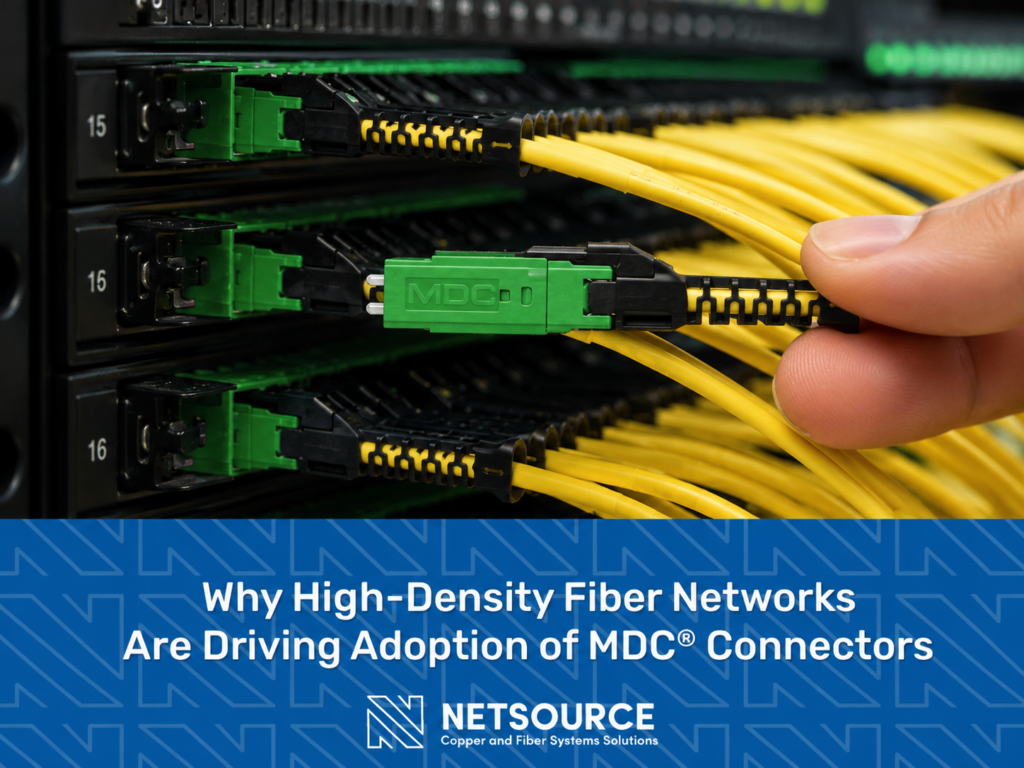

Closeup of tech inserting a MDC fiber connector into a high density patch panel. Why High-Density Fiber Networks Are Driving Adoption of MDC Connectors.
Fiber Infrastructure, High-Density Fiber Networks, LC Fiber Connectors, MDC connector

Why High-Density Fiber Networks Are Driving Adoption of MDC® Connectors

For years, the LC connector has been the standard for duplex fiber connectivity. It’s proven, widely adopted, and familiar to network designers across enterprise networks, telecommunications, and data center environments. So why are manufacturers, infrastructure providers, and network operators investing in a new connector platform? The answer isn’t simply higher bandwidth. It’s the growing need to increase connection density without continually expanding the network’s physical footprint. As compute environments become denser and applications such as cloud computing, AI, and hyperscale data centers continue to grow, operators are looking for ways to support more fiber connections within the same amount of rack and panel space. That’s where the MDC® connector, a registered trademark of US Conec, enters the conversation. The Challenge Isn’t Always Capacity When organizations begin planning network upgrades, discussions naturally focus on speed, throughput, and bandwidth. Those are important considerations, but they aren’t always the first limitation operators encounter. In many modern environments, physical density becomes the constraint long before bandwidth does. Patch panels fill. Rack space disappears. Expansion projects require additional cabinets simply because there is no room left to terminate additional connections efficiently. The cost of managing physical density can eventually become just as significant as expanding network capacity itself. This is particularly true in hyperscale data centers, cloud environments, AI infrastructure, and other applications where connection counts continue increasing year after year.   Why the MDC® Connector Was Developed The industry has introduced new connector platforms before, but successful adoption depends on more than creating a smaller connector. New connectivity solutions need to integrate into existing infrastructure, support evolving transceiver technologies, and deliver reliable optical performance while solving a real deployment challenge. The MDC® connector addresses one of today’s most common infrastructure challenges: maximizing fiber density without increasing the network’s physical footprint. Using industry-standard 1.25 mm ferrules, the MDC platform supports up to three times the connector density of traditional LC connectors within the same panel footprint. For organizations managing increasingly dense fiber environments, that additional capacity can help delay costly infrastructure expansion while making better use of existing rack space. MDC® and LC: Different Tools for Different Applications One misconception surrounding newer connector technologies is that they are intended to replace existing standards. That’s not really what’s happening here. The LC connector remains an excellent solution for many structured cabling systems and enterprise environments. It remains one of the most common duplex connector formats in production networks today. The MDC® connector addresses a different design challenge. When physical density becomes the limiting factor, a smaller connector footprint offers network designers another option to increase connection counts without fundamentally changing the surrounding infrastructure. Rather than replacing LC, MDC expands the design toolbox available to engineers planning next-generation fiber deployments. Integrating MDC® with Existing Fiber Infrastructure Adopting MDC doesn’t mean replacing an existing fiber plant. Most organizations will continue using a combination of connector platforms based on the needs of each portion of the network. LC connectors remain appropriate for many applications, while MPO/MTP® connectivity continues serving high-fiber-count backbone and trunk applications. The MDC® connector fits naturally between these established technologies by providing higher-density duplex connectivity where rack space and patch panel capacity have become operational constraints. For many organizations, migration is incremental rather than disruptive. New deployments can incorporate MDC, where higher density provides measurable value, while existing LC and MPO/MTP infrastructure continues supporting the broader network.   Where MDC® Connectors Make the Most Sense The MDC platform is particularly well-suited for environments where increasing connection density directly improves infrastructure utilization. Common examples include: High-density patch panels Hyperscale data centers AI infrastructure Cloud computing facilities Carrier and distribution networks Enterprise environments supporting 10G and 40G connectivity Modern 100G deployments Emerging 400G and 800G+ optical architectures The benefit isn’t simply supporting higher transmission speeds. It’s enabling more efficient use of available physical infrastructure as network demands continue to grow. Density Impacts More Than Space Discussions about connector density often focus on connection counts. The operational impact is usually more significant. As infrastructure becomes more crowded, routine maintenance becomes more difficult. Cable management becomes more complex. Moves, adds, and changes require additional planning. Troubleshooting takes longer because technicians have less room to work within densely populated panels. Higher-density connector platforms help address these operational realities by improving space utilization while maintaining organized, serviceable infrastructure. For many organizations, that’s just as valuable as adding additional ports.   Looking Ahead Network infrastructure continues to evolve alongside the growing demand for cloud services, AI workloads, and increasingly connected environments. Connector technology is evolving with it. The MDC® connector represents a practical response to one of today’s most common infrastructure challenges: supporting more connectivity without continually expanding physical infrastructure. As organizations begin evaluating higher-density fiber architectures, connector selection becomes part of a broader infrastructure strategy rather than simply a component decision. NetSource is expanding its connectivity portfolio with MDC-based custom fiber assemblies designed to support modern network environments. Beyond manufacturing assemblies, NetSource works with customers to evaluate connector platforms, assist with migration planning, develop custom fiber solutions, and help identify the right connectivity approach for each application. Whether planning a new deployment or preparing for future growth, understanding how connector density influences long-term infrastructure scalability is becoming an increasingly important part of modern network design. Call NetSource or contact us online to schedule a time to discuss your project requirements with a member of our team. 

Scroll to Top