Author name: admin

Open fiber optic distribution box with multicolored fiber cables. Article title.
Splice Terminals, OptiTap Splice Terminals (OST), Single Fiber Splice Terminals (SFST), Stubless Splitter Terminals (SST)

Types of Splice Terminals and How to Choose the Right One

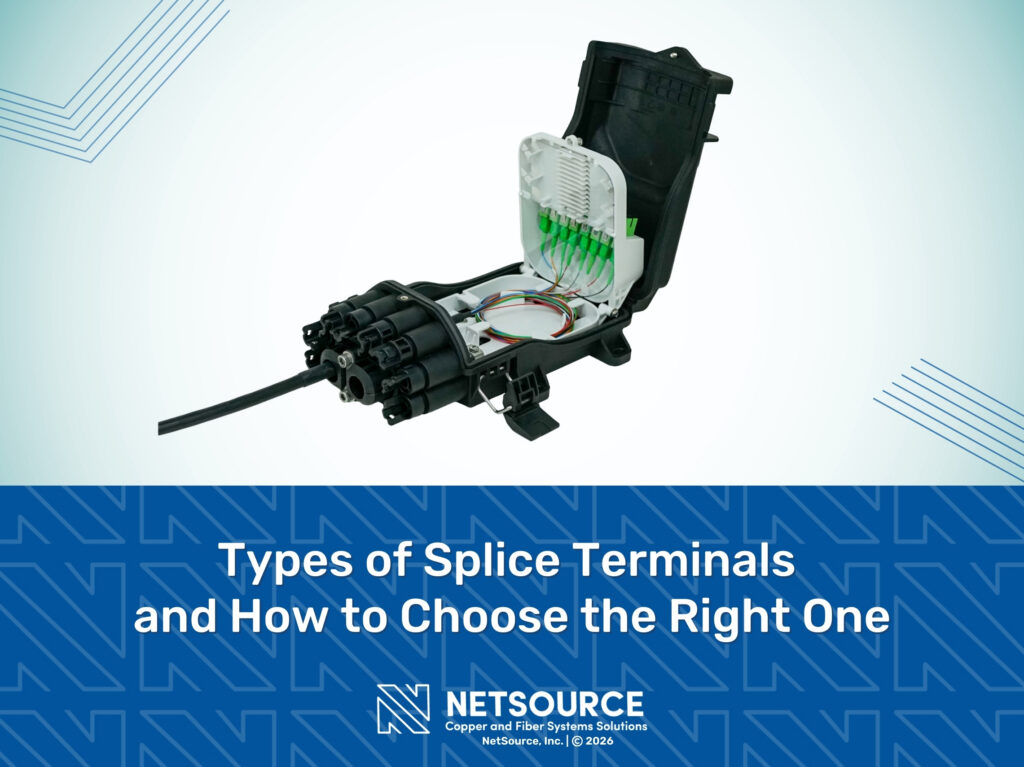
In fiber optic networks, splice terminals are critical components that enable seamless connectivity by serving as junction points for splicing, splitting, and distributing optical fibers. With several types of splice terminals available, each designed for specific applications, selecting the right one can significantly impact network performance and efficiency. This article explores the types of splice terminals offered by NetSource Solutions and provides guidance on choosing the best option for your project. What Are Splice Terminals? Splice terminals are enclosures or units used to join optical fibers through fusion or mechanical splicing. They often integrate features for splitting, distribution, and cable management, making them essential for both passive optical networks (PON) and active fiber deployments. These terminals protect spliced connections from environmental factors and ensure network reliability.   Types of Splice Terminals NetSource Solutions offers several types of splice terminals to meet diverse networking needs: 1. OptiTap® Splice Terminals (OST) Features: IP68-rated for water and dust ingress protection. Available with 4, 8, or 12 hardened SC/APC adapters. Pre-loaded with splice trays and pigtails. Applications: Ideal for outdoor installations, such as a strand, pole, pedestal, or ground-vault mounting. Suitable for fiber-to-the-home (FTTH) and fiber-to-the-business (FTTB) networks. Advantages: Provides robust environmental protection. Simplifies fiber distribution and splicing in outdoor settings. 2. Single Fiber Splice Terminals (SFST) Features: Supports up to 16 subscribers. Splice capacity of 96 fibers (4 trays x 24 fibers per tray). IP68-rated for use in harsh outdoor environments. Applications: Aerial strand, pole, pedestal, and ground vault installations. Designed for dense residential and commercial deployments. Advantages: Combines splicing, splitting, distribution, and storage. Compact design optimized for high-density networks. 3. Stubless Splitter Terminals (SST) Features: Designed for fiber splitting without terminal splicing. Available in configurations with 1×4 or 1×8 splitters. Compatible with OptiTap® cables. Applications: FTTH networks require efficient distribution with minimal splicing. Outdoor installations in rural and suburban environments. Advantages: Reduces installation time by eliminating in-field splicing. Cost-effective for extending fiber networks. How to Choose the Right Splice Terminal Selecting the right splice terminal depends on several factors, including your network’s scale, location, and specific requirements. Here’s a step-by-step guide to help you make the best choice: 1. Assess the Installation Environment For outdoor installations, opt for terminals with high ingress protection ratings (e.g., IP68) to withstand environmental challenges such as water, dust, and temperature fluctuations. Consider mounting options such as pole, strand, pedestal, or ground vault to ensure compatibility with the site. 2. Determine Capacity Needs Evaluate the number of fibers that need to be spliced or split at each terminal. For high-density deployments, choose options such as SFST that offer higher splice capacities. 3. Evaluate Functional Requirements If your deployment requires both splicing and splitting, look for terminals that integrate these functions, such as SFST or SST. For networks focused on rapid deployment, stubless terminals like SST minimize installation time. 4. Compatibility with Network Architecture Ensure the terminal’s design aligns with your network’s architecture, whether it’s a PON, active Ethernet, or hybrid setup. Check compatibility with specific cable types and connectors, such as OptiTap®. 5. Prioritize Cost-Effectiveness Balance upfront costs with long-term reliability and maintenance requirements. Opt for terminals that simplify installation and reduce the need for specialized tools or labor. Benefits of Using NetSource Splice Terminals NetSource Solutions’ splice terminals are engineered for durability, efficiency, and adaptability. Here’s what sets them apart: U.S.-Based Manufacturing: High-quality products built and tested in the United States. Customizable Solutions: Options for tailored configurations to meet specific project needs. Rapid Turnaround Times: 24-hour assembly capabilities ensure timely delivery. Stringent Quality Standards: All products undergo rigorous testing to guarantee performance and reliability. Enhance Network Reliability with the Ideal Splice Terminal Splice terminals are essential for building and maintaining robust fiber optic networks. By understanding the unique features and applications of each type, you can choose the best solution for your specific needs. Whether you require the rugged reliability of OptiTap® Splice Terminals, the high capacity of SFST, or the streamlined efficiency of SST, NetSource Solutions offers the perfect product to support your deployment.Ready to enhance your network? Contact NetSource Solutions today for expert guidance and premium-quality splice terminals tailored to your project.

Three blue fiber connectors attached to yellow cables. Article title.
Fiber Connector, LC Fiber Connectors, MPO/MTP® connectors, SC & ST Connectors

Improve Network Uptime With the Right Fiber Connector

Fiber connectors are essential components in fiber optic networks. They join fiber optic cables together, allowing light signals to pass through with precision and minimal loss. Without the right connectors, network performance can degrade. This leads to data transmission issues with a costly downtime. Fiber connectors influence everything from signal clarity to the physical space within a network rack. They also play a key role in deployment speed and long-term maintenance. As a trusted cable manufacturer based in the USA, NetSource provides high-quality, custom-built fiber assemblies designed to meet your network’s specific needs.   Why Fiber Connector Types Matter for Network Efficiency The type of fiber connector you choose can make a noticeable difference in how efficiently your network performs, how much space it uses, and how easily it can be scaled. Here are the main factors impacted by connector selection: Signal Loss: Choosing a connector that aligns well with your fiber type helps reduce insertion and return loss, maintaining data integrity. Port Density: Smaller connectors, such as LC, allow for more connections within a limited space, which is critical in compact or high-density setups. Installation Time: Certain connector types simplify installation and testing, speeding up deployment. Upgrade Paths: Scalable, high-density connectors make it easier to expand or reconfigure the network later. By selecting the proper fiber connector from the start, you can minimize downtime, save on labor, and future-proof your infrastructure.      Common Fiber Connector Types  LC Fiber Connectors Size: 1.25mm ferrule (small form factor) Use Cases: Perfect for high-density environments such as data centers Modes: Compatible with both single-mode and multimode applications SC Connectors Size: 2.5mm ferrule with push-pull design Use Cases: Common in telecom and enterprise networks Features: Durable, simple to connect and disconnect ST Connectors Design: Bayonet-style with a 2.5mm ferrule Use Cases: Used in legacy LANs and industrial systems Features: Quick-connect design, though less common in modern networks MTP® and MPO Connectors Fiber Count: 12, 24, or more fibers in one connector Use Cases: Best for high-speed, high-volume data networks Deployment: Fast, plug-and-play in data centers MTP®: Enhanced version of MPO with tighter tolerances and improved performance Polish Types and What They Mean (APC, UPC, PC) APC (Angled Physical Contact): End-face polished at an 8-degree angle to reduce return loss; ideal for video and high-frequency data UPC (Ultra Physical Contact): Flat surface with tighter tolerances; provides low insertion loss PC (Physical Contact): Standard polish; suitable for general applications The polish type affects signal quality, especially in high-bandwidth and long-distance scenarios.   Simplex vs. Duplex Fiber Connectors Simplex: Supports one-way data transmission, making it useful for one-directional communication setups Duplex: Enables simultaneous two-way transmission; standard for most network environments Choosing between simplex and duplex depends on your system’s data flow requirements Single-Mode vs. Multimode Connector Compatibility Single-Mode (9/125 µm): Used for long-distance communication and higher bandwidth Multimode (50/125 µm or 62.5/125 µm): Ideal for shorter distances and local area networks (LANs) Not all connector types are suitable for both modes, so compatibility with your fiber type is critical. Field-Terminated vs. Pre-Terminated Fiber Connectors Field-terminated fiber connectors are installed directly on-site. This method gives technicians the flexibility to adapt and customize connections during installation. However, it requires skilled labor and can be time-consuming due to the precision and tools needed to ensure a clean, reliable connection. Pre-terminated fiber connectors are assembled and tested at the factory before deployment. This option offers a faster, more efficient installation process with fewer chances for error. As a U.S.-based cable manufacturer, NetSource provides custom pre-terminated fiber assemblies tailored to your exact specifications. Thus ensuring high performance and reduced field labor.   Choosing the Right Fiber Connector for Your Network When selecting a fiber connector, consider: Factor Recommendation Network Size Larger networks may benefit from high-density connectors like LC or MPO Equipment Compatibility Match connectors with ports on switches, routers, and panels Connector Type LC for density, SC for durability, MPO for multi-fiber deployment Polish Type APC for return loss-sensitive uses, UPC for general data transmission Fiber Mode Match connector to single-mode or multimode fiber used Environment Use weather-resistant or ruggedized connectors for outdoor or industrial installs Best Practices for Fiber Connector Installation and Maintenance Clean connector end-faces with lint-free wipes and alcohol Avoid excessive bending or tension on fiber cables Use proper cable management and strain relief techniques Regularly inspect connectors for dirt, damage, or misalignment Keep dust caps on unused connectors to prevent contamination Why Work With a U.S.-Based Cable Manufacturer Working with a U.S.-based cable manufacturer offers several advantages that can make a tangible difference in both project delivery and long-term network performance. Faster turnaround times are possible thanks to domestic production, which helps reduce shipping delays and keeps projects on schedule. Compliance is another key benefit. NetSource fully supports BABA (Build America, Buy America) requirements, making it easier for clients to meet federal and government sourcing standards. Quality assurance is built into every product we manufacture, backed by ISO 9001:2015 certification that ensures consistent, high-performing components. NetSource offers highly customizable solutions across broadband, wireless, and infrastructure categories, allowing clients to receive products tailored precisely to their application needs. Looking for technical specs? Download our fiber connector catalog to see detailed options.   FAQs About Fiber Connectors What’s the difference between LC and SC connectors? LC connectors are smaller and ideal for dense patch panels, while SC connectors are larger and known for durability. Can I mix multimode and single-mode connectors? No. Mixing modes leads to signal loss. Always match the connector mode to the type of fiber cable. How do I know which polish type I need? Choose APC for applications requiring low return loss (such as video), and UPC for typical data transmission. What is the most future-proof fiber connector type? MTP®/MPO connectors offer scalability for high-bandwidth networks and are ideal for future growth. What are SC and LC connectors? SC connectors use a 2.5mm ferrule and feature a push-pull mechanism, making them reliable and easy to use in telecom environments. LC connectors with a smaller 1.25mm ferrule

Featured image for : Selecting Cable Assemblies for Harsh Environments
Cable Assemblies for Harsh Environments in the USA, Cable Assemblies, Cable Assembly Requirements, Outdoor Fiber Cable, Tactical and Military-Grade Cable Assemblies

Selecting Cable Assemblies for Harsh Environments in the USA

Selecting the right cable assemblies for harsh environments can be the difference between system failure and long-term reliability. If you’re searching for durable, high-performance cable assemblies that withstand extreme conditions like moisture, heat, chemicals, and mechanical stress, this guide is for you. In this article, we’ll walk you through exactly what to look for in rugged cable assemblies, break down key features, and explain when custom solutions are necessary. Whether you’re in the military, aerospace, telecom, or industrial sector, NetSource is here to help you find the right solution. Based in the USA, we specialize in building custom cable assemblies engineered for performance and longevity. If you’re ready to get started with the right cabling solution for your environment, contact NetSource today. Understanding Harsh Environments and Cable Assembly Requirements Cable assemblies for harsh environments must be designed to withstand harsh environmental factors that would quickly degrade or destroy standard cables. These environments often involve exposure to water, dust, oil, chemicals, extreme temperatures, UV radiation, and constant movement or vibration. For example, extreme heat and cold, as defined by the National Weather Service, can significantly affect how cable materials expand and contract and how they perform over time. In such conditions, ordinary cables can break down, leading to system failures, safety risks, or costly downtime. That’s why choosing the proper cable assembly is essential to ensure performance, durability, and safety. Properly engineered cable assemblies protect internal components and maintain signal integrity, even in the most severe environments. Key Features To Look for in Cable Assemblies for Harsh Environments When selecting harsh environment cable assemblies, look for the following features: Durable jacketing materials: Materials like TPE, TPU, PVC, and fluoropolymers provide strong protection against environmental stress. Shielding for EMI/RFI protection: Options include foil, braid, and drain wire to prevent signal interference. High-flex designs: For applications with frequent movement or bending, cables must be built to resist fatigue and breakage. Resistances to key elements: Water and moisture (waterproof cable assemblies) UV exposure from sunlight Oil and harsh chemicals Abrasion and crushing forces These features help extend the life and reliability of cable systems in demanding applications. Tactical and Military-Grade Cable Assemblies Tactical cable assemblies are built specifically for use in mission-critical applications, including military, aerospace, and field communications. These cables are designed for portability, ruggedness, and quick deployment. Key characteristics include: TFOCA cables: Rugged fiber connectors used in military-grade applications MIL-spec compliance: Meets strict U.S. military standards Field-replaceable components: Easy to maintain and adapt in challenging environments Durability:  Resistant to crushing, bending, and harsh weather Military and aerospace cables are engineered to ensure signal integrity under stress, whether in combat zones or aerospace missions. For more insights, read about our custom cable assemblies for defense or explore our military-grade cable solutions. Outdoor Fiber Cable Solutions for Harsh Conditions Fiber optic cables are often used in outdoor and industrial settings, but not all fiber cables are suited for exposure to the elements. Choosing the right outdoor fiber cable solutions involves understanding construction types and protective features. Loose tube vs. tight-buffered: Loose tube fiber offers more protection for outdoor use; tight-buffered is easier to install in buildings. Water-blocking materials: Gels, dry yarns, and tapes prevent moisture from entering the cable. Rodent-resistant and armored options: Protect against physical damage when buried or exposed. UV and weather protection: Outer jackets must resist sunlight, rain, and temperature shifts. Properly chosen outdoor fiber cables help maintain high-speed connectivity in harsh environments. If you’re considering enclosures or additional protection, review our fiber and copper enclosures. When To Choose Custom Cable Assemblies Not all applications can be solved with off-the-shelf cables. Custom cable assemblies allow you to match specific technical, environmental, and installation needs. Why go custom: Standard cables may lack features required for unique systems or may not fit within space or routing limits. Benefits: Tailored lengths, connectors, and materials Enhanced compatibility and performance Reduced installation time and error Design process: Define system needs and environmental conditions Choose components (jacket, shielding, connectors, etc.) Prototype and test before full production Custom assemblies are ideal for high-stakes or highly specialized projects in fields like aerospace, telecom, and industrial automation. You can explore our custom cable builds to see how NetSource supports specialized environments. Key Questions To Ask Before Choosing a Cable Assembly To make the proper selection, start by answering these questions. If you’re looking for durable modular interconnects, check our fiber patch cords and patch panels for harsh environments. What environmental hazards will the cable face? Will it experience regular movement or stress? Is there a need for EMI or RFI shielding? Are there size or routing constraints? Are compliance standards required (ISO, UL, MIL-STD)? These questions help narrow down options and avoid common mistakes. Essential Components Inside Rugged Cable Assemblies The strength and performance of harsh environment cable assemblies come from their internal components: Strength members: Aramid fibers, fiberglass rods, or steel cores add tensile strength. Breather tubes: Help release pressure and protect internal wiring. Fillers: Maintain shape, add protection, and improve performance. Separators/barriers: Prevent components from rubbing or sticking together. Outer jackets: Defend against mechanical and chemical threats. Waterproofing: Tapes and gels that seal against water ingress. Each part plays a critical role in building a cable assembly that can last under stress. Learn about field test cords for cable validation that support your installation and QA processes. Choosing a USA-Based Cable Assembly Manufacturer Working with a domestic supplier offers several advantages: Faster delivery times Easier technical support and communication Stronger adherence to U.S. quality standards, like ISO 9001:2015 You can also learn more about our wireless-ready rugged cabling and how we support diverse industry environments. Before choosing a supplier, ask some questions:  Do they offer prototyping and testing? Can they meet compliance needs (e.g., military or aerospace)? What’s their experience with harsh environment projects? For example, if you’re looking for rugged fiber interfaces, our OptiTap®-compatible solutions and OptiTip® cable configurations are engineered for outdoor reliability. NetSource is a trusted USA-based manufacturer of custom cable assemblies for harsh

(BEAD) Broadband Equity Access and Deployment, BEAD Program Implementation Challenges

Empowering Communities: How the Broadband Equity Access and Deployment Program Is Making a Difference

Empowering Communities: How the Broadband Equity Access and Deployment Program Is Making a Difference With the Broadband Equity Access and Deployment (BEAD) Program’s historic $42.45 billion investment in broadband solutions, the USA is ready for a connectivity revolution. We are ready to bridge the digital divide and bolster local economies, education, and healthcare through enhanced internet access. This article discusses how the BEAD program is making a difference in underserved and unserved areas throughout the USA. Understanding BEAD: Connectivity for All Through Broadband Solutions With how far society has come, especially post-COVID-19, broadband solutions are no longer optional. We have started down a road that there is no turning back from. Access to this vital infrastructure makes the difference when it comes to community growth and individual opportunity in the USA. Specifically targeting communities lacking adequate internet services, BEAD defines ‘unserved’ areas as those without access to broadband speeds of at least 25 Mbps download and 3 Mbps upload. ‘Underserved’ communities, on the other hand, do not reach broadband thresholds of 100 Mbps download and 20 Mbps upload. Key Features of BEAD: Expanding Reach: BEAD is pouring resources into creating new broadband wireless networks and enhancing older infrastructures. The program aims to reach the ‘last mile’ areas previously untouched by reliable internet. Tailored Solutions: Recognizing the unique challenges of diverse locales, BEAD supports custom data cables and specialized network solutions, ensuring that each community gets what it needs. There is a clear understanding that these improvements aren’t a one-size-fits-all fix. Tech Empowerment: Beyond just getting broadband access, the program is a launchpad for digital know-how. It provides resources for communities to gain a shared understanding of how to manage and thrive through broadband management solutions. NetSource matches BEAD’s ambition with fiber optic broadband and custom solutions. These will empower communities, drive education, and bolster local economies. Expanding Broadband Reach Through USA Infrastructure Development With BEAD The BEAD program transforms the digital landscape by replacing outdated copper networks with high-capacity fiber optics, essential for broadband wireless networks. This upgrade caters to the growing demand for high-speed broadband solutions, facilitating faster and more reliable internet across the USA. The focus is also on enhancing broadband wireless networks by deploying small cell sites that extend the reach and capacity of 5G networks. Industry professionals now face a surge in projects involving the installation of advanced network cables and custom data cables. The ultimate goal is to provide comprehensive broadband network solutions. This initiative marks a significant leap toward enabling seamless access to digital services and fostering economic growth in previously underserved communities. Catalyzing Digital Inclusion: Affordability and Literacy for Broadband Network Solutions Within the broad spectrum of BEAD’s transformative agenda, affordability and literacy emerge as critical pillars. These elements are fundamental in making sure that broadband access translates into practical, empowering tools for communities. Affordability: BEAD tackles the cost barrier head-on, mandating that fiber optic broadband services provided under its umbrella are within financial reach. This initiative seeks to prevent a scenario where the price point becomes a divide in itself, standing between users and the wealth of online resources. Digital Literacy: Beyond access, BEAD invests in programs that foster digital competence. Recognizing that access without ability is an incomplete solution fuels educational initiatives designed to equip individuals with the skills needed to navigate and benefit from these improvements. BEAD is setting the stage for a more inclusive digital tomorrow, with connected citizens who are knowledgeable about their broadband interactions. Navigating the Roadblocks: BEAD Program Implementation Challenges in the United States While the program has many great benefits, you need to consider the challenges that come with this extended broadband reach. Whether you’re setting up business broadband solutions or residential infrastructures, you need to tactically overcome the inherent hurdles of this ambitious initiative, including: Geographical Complexities: The topography of target areas can complicate the deployment of broadband wireless network solutions. You need to strategize ways to balance quality, cost, and adaptability. This is especially true when you place network cables in remote areas or over rugged terrain. Regulatory Navigation: The maze of regulations that varies by locality necessitates a proactive approach. ISPs must ensure seamless coordination and comprehension of policies. These mitigate delays and implement broadband management solutions that adhere to diverse regional mandates. Workforce Dynamics: The scarcity of skilled labor, particularly installers proficient in fiber optic broadband and custom data cables, can stall progress for the BEAD program. Implementing innovative training programs and efficient labor utilization strategies can sustain the pace of broadband expansion. Sustaining Viability: Getting a significant return on investment means focusing on the long-term from the start. You need to look beyond the initial setup and assess your infrastructure’s ongoing upkeep and scalability. It needs to meet the evolving community demands while optimizing the use of BEAD funds. Upholding Security: With the spotlight on network security, you get tasked with safeguarding user data as part of the infrastructure, especially if you provide business broadband solutions. This is a non-negotiable aspect of the BEAD program that fortifies customer trust and satisfaction. Each challenge presents an opportunity for providers to demonstrate their expertise in broadband solutions, regardless as to whether the solutions are related to broadband for businesses, management, or networks. By adopting a holistic and foresighted approach, you can effectively utilize BEAD resources. That way, you meet the present needs and set communities up for future generations. Let NetSource Be Your Partner as You Implement Your BEAD Strategy Across the U.S. Community leaders and ISPs must partner with seasoned experts to craft custom broadband solutions as the nation rallies behind the BEAD program. Contact NetSource to find out how our solutions can align with your community’s goals for the BEAD program. Together, we can enhance the efficacy and longevity of your connectivity projects. NetSource, Inc May 2, 2024

IoT Integration , Smart Buildings, Wireless Solutions

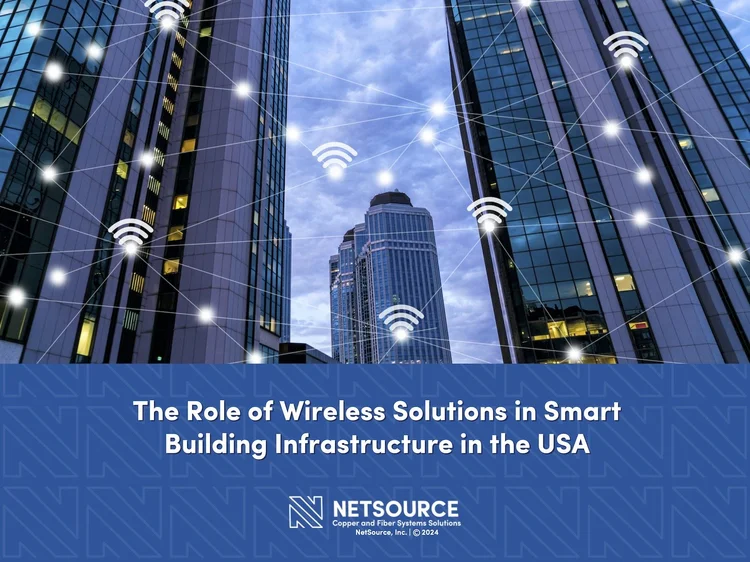
The Role of Wireless Solutions in Smart Building Infrastructure in the USA

The Role of Wireless Solutions in Smart Building Infrastructure in the USA Smart building infrastructures across the USA are reshaping wireless solutions. As the market surges toward an additional $46.12 billion in growth by 2027, NetSource stands at the forefront. We offer cutting-edge cable solutions for today’s most advanced facilities, ranging from fiber optic cables to fixed 5G wireless access. This article explores network cables, communication cables, and connection cables, as well as the role wireless solutions play in enhancing the functionality and sustainability of smart buildings. Critical Components of Wireless Infrastructure in the USA  Imagine a building that adapts to your needs before you even ask. That is what smart buildings do. They stand at the forefront of technological integration, harnessing the power of wireless solutions to revolutionize how structures operate and serve their occupants. These buildings use sophisticated networks that connect various devices and systems to enhance functionality and efficiency. Wireless technology plays an important role in transforming them from traditional spaces. They become responsive environments that adapt to the needs of occupants while promoting sustainability and safety. Below, we list the components that enable this high level of integration and control. 1. Get High-Speed Connectivity by Implementing Effective Wireless Solutions  As you plan your wireless network installations in smart buildings, your first focus should be on the role of high-speed internet and the necessary components to facilitate those speeds, such as custom small cell cables. Cutting-edge technologies like 5G and Wi-Fi 6 revolutionize wireless connectivity. These technologies provide the backbone supporting various applications, from data-intensive operations to complex building automation. 5G Implementation: Employing 5G involves fixed wireless access and integrating custom small cell cables to support higher bandwidth and lower latency. In turn, it enhances the efficiency of real-time operations in your smart building network. Leveraging Wi-Fi 6: When you install Wi-Fi 6, you ensure wider coverage and reliable connectivity that can handle multiple IoT devices simultaneously. 2. Smart Buildings and IoT Integration  Incorporating IoT devices into your smart building connectivity infrastructure designs requires you to create a wireless network that can handle multiple communication systems at the same time. Whether you need to integrate smart thermostats or advanced security systems, you need them to communicate effectively. Ultimately, that enhances operational efficiency and overall building intelligence. Seamless Device Connectivity: Uses specialized network cables to facilitate a network that seamlessly connects various IoT devices. This setup allows for comprehensive control and management, enhancing the building’s adaptability to different operational demands. Enhanced Security and Surveillance: Integrate advanced communication cables to connect IoT-enabled security devices. This setup helps real-time monitoring and immediate response to security breaches, reinforcing the safety of the premises for the end user. 3. Communication Cables’ Role in Energy Management  Wireless solutions enable smart buildings to achieve remarkable energy efficiency. By strategically placing sensors and implementing automated systems, you can help buildings reduce their energy footprint significantly—translating into cost savings and environmental benefits. Smart Energy Protocols: Integrate wireless sensors and automated controls using durable and reliable network cables. These systems adjust heating, lighting, and air conditioning based on real-time data, optimizing energy use across the building. Therefore, you need to ensure they don’t compromise integrity and durability. Sustainability Practices: By employing IoT technologies interconnected through extensive wireless solutions, your building network infrastructure can monitor and actively reduce energy consumption. This supports the broader sustainability goals of smart building construction. Smart buildings get even smarter when you introduce state-of-the-art wireless technology. You build a network with the tools to enhance efficiency, security, and sustainability. Each wireless solutions installation you complete contributes to operational excellence and paves the way for future advancements in building technology. NetSource’s Contribution to Infrastructure in the United States: Wireless Solutions  At NetSource, we understand that each smart building project has its own set of unique requirements. Custom network, connection, and communication cable solutions come tailored to meet the specific needs of your wireless solutions infrastructure. We design our custom small cell and fiber optic cables to integrate seamlessly with your existing systems. They enhance the efficiency of fixed wireless access 5G networks used in modern smart buildings. When it comes to connection cables, fiber optic cables, or communications cables, we ensure each piece works just right for what you need on the job. Customization like this improves the reliability and performance of your smart building while also future-proofing your investments. They stand ready for all of the evolving technological advancements to come. What the Future Holds for Smart Buildings in the USA As wireless technology continues to evolve and improve, we will see more adaptive and intelligent building infrastructures. The future of wireless solutions will most likely include personalized space management, enhanced predictive maintenance, and even more advanced energy efficiency. All of these new approaches need the support of a comprehensive and customized wireless system that can keep up. Elevate Your Smart Building Capabilities With NetSource’s Wireless Solutions As wireless solutions revolutionize USA smart building infrastructure, we see unmatched control and efficiency in modern environments. As the push for more interconnected and intelligent facilities grows, the backbone provided by our cable solutions at NetSource acts as the key. For those advancing the development and management of smart buildings, tapping into this technology is critical to future advancements. Contact us today to explore how our innovative products can transform your projects

Broadband Solutions, Custom Data Cables, Wireless Networks

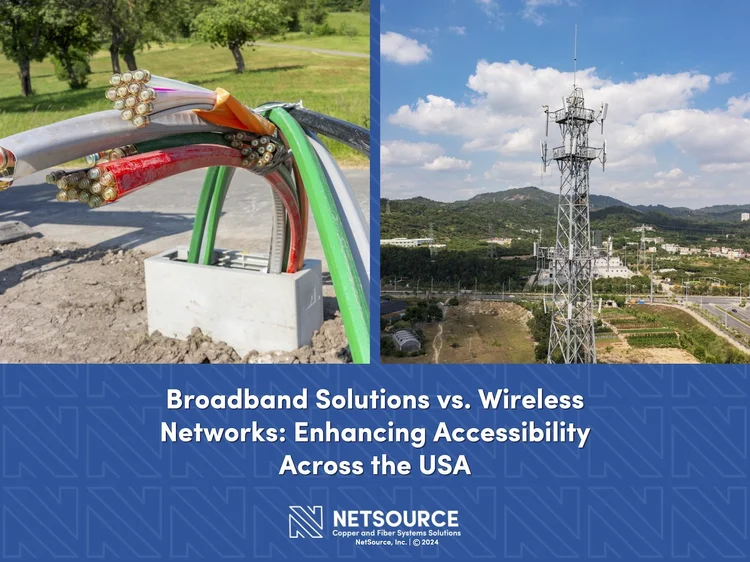
Broadband Solutions vs. Wireless Networks: Enhancing Accessibility Across the USA

Broadband Solutions vs. Wireless Networks: Enhancing Accessibility Across the USA By 2029, 98% of Americans will have access to the Internet, reflecting a significant stride toward nationwide digital connectivity. This surge in accessibility raises important questions about the comparative reach and efficiency of broadband and wireless networks. This article examines how each contributes to bridging the digital divide in diverse American regions. We compare the roles and accessibility of broadband solutions vs. wireless networks and highlight how innovative solutions from NetSource enhance internet accessibility across the USA. Clarifying Broadband Solutions vs. Wireless Networks: Are They the Same?  When you build a digital infrastructure, understanding the distinction between broadband solutions vs. wireless networks helps you deploy effective internet services. Broadband solutions encompass various high-speed internet technologies primarily delivered through wired connections such as DSL, fiber optic, and cable. These technologies provide stable and high-capacity connections. They create the backbone for internet services and large-scale data operations. unlike broadband solutions, wireless networks utilize technologies like Wi-Fi and fixed wireless access (FWA) to provide internet access without needing physical cabling. These wireless networks offer quick deployment and flexibility in geographic areas where traditional wiring is impractical. Accessibility of Broadband Solutions in the U.S. The accessibility of broadband solutions hinges significantly on the availability of advanced cabling solutions like custom fiber optic cables. Known for its reliability and high-speed capabilities, broadband is indispensable for supporting demanding applications. In fact, cable internet is available to nearly 90% of U.S. households. It has a widespread reach and extensive infrastructure already in place. However, the deployment of broadband infrastructure requires careful planning and significant investment. This is particularly seen in less urbanized areas where laying cables can be logistically challenging and economically demanding. Accessibility of Wireless Networks  Wireless network technologies, such as 5G and Wi-Fi 6, have redefined the accessibility of internet services. This impacts regions where laying physical cables is not feasible. In comparison to broadband solutions, wireless networks offer considerable advantages in terms of scalability and ease of expansion. Service providers can extend internet access to remote and underserved areas more rapidly. However, the level of access varies. In regions with strong wireless infrastructure, users can enjoy the high-speed benefits of a 5G network. Others might only have access to LTE. These networks, while flexible, face challenges related to signal interference and bandwidth limitations, particularly in densely populated or geographically complex areas. This creates the need for a strategic approach to placing antennas and repeaters to optimize signal strength and coverage. Broadband Solutions vs. Wireless Networks: Differences  Understanding these key differences and accessibility challenges between broadband solutions vs. wireless networks allows you to select the best technology and strategy for deploying internet services across geographic regions in the USA. At NetSource, we provide the foundational components you need. We have everything from cutting-edge telecommunications cables to custom network solutions that support both broadband solutions and wireless networks. We enable both to thrive and expand their reach. Leveraging Cable Manufacturer Technology: Broadband Solutions vs. Wireless Networks  Choosing the right type of connectivity can significantly impact your operational efficiency and business growth. With broadband solutions, your customers get high-speed data transmission that works for cloud computing, large-scale backups, and heavy data transactions. Whereas wireless network solutions have slightly slower data transmission speeds but offer incredible flexibility and reduced installation times. The Role of Custom Data Cables in Connectivity Across the USA Any reliable network requires an emphasis on quality cabling. At NetSource, we understand that effective connectivity requires seamless, uninterrupted service and the ability to scale efficiently. We craft our custom fiber optic cables and broadband infrastructure to address the unique demands of diverse business environments. With our custom data cables, you can support both broadband and wireless networks. Tailored Performance: The design of our custom small cell cables enhances signal quality and reduces latency. This is important for maintaining robust connections in dense urban settings or extensive corporate campuses. Enhanced Durability: Our custom fiber optic cables utilize high-quality materials and withstand environmental challenges. They provide long-term reliability and reduce the need for frequent replacements. Scalability Solutions: Our telecommunications cables adapt as your network needs increase. Whether expanding a current setup or integrating new technologies, our cables provide the backbone for future growth. Precision Design: We meticulously tailor each cable configuration to meet specific operational requirements. With our cables, you get optimal performance across various applications, from high-speed data centers to intricate telecommunications networks. By focusing on high-quality, custom data cable solutions, we help you meet current connectivity needs while also preparing you for future needs. With NetSource cables, you’re investing in a foundation that supports expansive growth and technological evolution. Partner With NetSource for Future-Ready Connectivity in the United States At NetSource, we provide you with connectivity solutions that propel your business forward. We help with both broadband and wireless networks’ roles tailored to ensure that your connectivity infrastructure is a strategic asset. Contact us today to explore how our broadband network solutions and innovative wireless setups can transform your business connectivity. We don’t just work to provide you with what you need today—we anticipate the technological demands of tomorrow

C-Band Deployment, Broadband Expansion, Rural broadband.

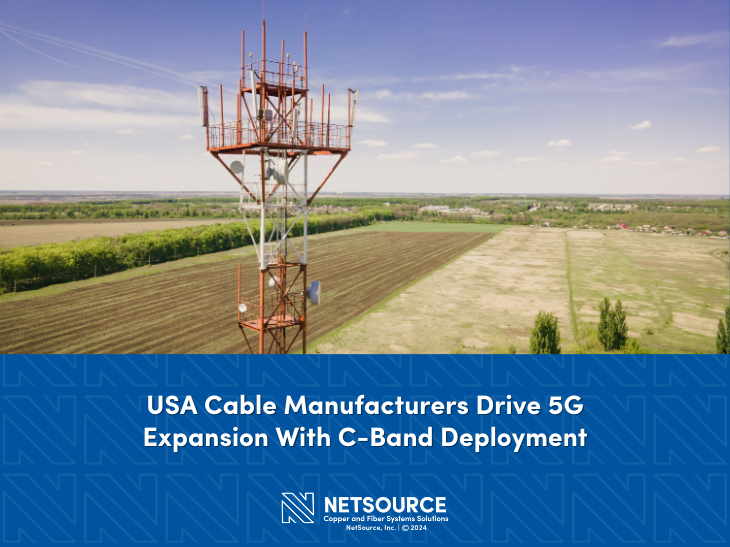
USA Cable Manufacturers Drive 5G Expansion With C-Band Deployment

USA Cable Manufacturers Drive 5G Expansion With C-Band Deployment Over 70% of new 5G C-Band spectrum is being deployed by cable manufacturers in the USA this year. This expansion helps to enhance nationwide connectivity each and every day. At NetSource, we work hard to make sure that your infrastructure matches the technological demands. This article explains how C-Band deployment impacts 5G adoption and innovation across the United States. Bridging the Rural Digital Divide With C-Band Deployment As C-Band is used more frequently throughout the communications industry, it shines as a game changer for bridging the rural digital divide. C-Band offers a balanced blend of coverage and performance through its unique mid-band spectrum. That makes it a great option for extending 5G’s reach into rural areas. Traditionally, these areas struggled to access connectivity with the same internet opportunities. Here’s how C-Band makes a difference: Extensive Coverage: C-Band’s impressive propagation characteristics allow signals to travel longer distances and penetrate buildings more effectively than higher frequency bands. This means reliable service in rural and suburban areas, reducing the isolation felt by these communities or frustration with interrupted service. Enhanced Capacity: As your customers enjoy faster download speeds and smoother streaming, they find that C-Band also increases network capacity. This allows more users to connect simultaneously without degradation in service quality—an important factor during peak times. Reduced Costs: By utilizing C-Band, you can deploy fewer cell sites over larger areas. This significantly reduces the infrastructure costs of bringing high-speed internet to remote locations. This cost efficiency accelerates the rollout of services, ensuring that more communities benefit sooner rather than later. C-Band at Work: Cable Manufacturers in the USA Powering Business Innovation C-Band’s deployment goes beyond giving communities fast internet. It’s about enabling businesses throughout the USA to harness the full potential of 5G technologies, driving productivity and innovation. Here’s how businesses stand to benefit: Cloud Applications and IoT: With C-Band, businesses in your network area can leverage cloud technology and IoT solutions more effectively. The band’s capacity for high-speed data transfer and low latency ensures that real-time data processing and analytics can happen seamlessly. This empowers businesses to make quicker, data-driven decisions. Enhanced Communication Solutions: Multi-core fiber optic cables and advanced communication infrastructure supported by C-Band enhance the reliability and quality of business communications. This supports everything from video conferencing to large-scale data transfers between branches spread across the country. Fixed Wireless Access (FWA): C-Band communications cable has taken a prime role in FWA. It provides a cost-effective alternative to traditional wired connections, offering businesses and homes high-speed broadband without the extensive physical infrastructure. This is particularly transformative for rural businesses, where laying fiber can be prohibitively expensive and logistically challenging. Future-Proofing Connectivity With C-Band In addition to the here and now, the deployment of C-Band cable assembly infrastructures increases the expansion and enhancement of 5G technologies across the USA. Here’s how C-Band directly influences 5G adoption and sparks innovation: Enhanced Network Capacity Partnering with cable manufacturers in the USA, like NetSource, for C-Band’s deployment significantly increases network capacity and reliability. This strikes a perfect balance between coverage and speed, allowing for denser network deployments without the extensive infrastructure required by higher frequency bands. This means businesses and consumers experience fewer interruptions and higher data throughput needed for applications like real-time video streaming and large-scale IoT deployments. Driving Economic Growth As C-Band enhances network capabilities, it also opens doors to new economic opportunities. Enhanced 5G networks foster innovation in sectors like telemedicine, smart cities, and automated manufacturing, providing the backbone for these technologies to thrive. This, in turn, fuels job creation and stimulates economic activities in technology-driven sectors. Catalyzing Technological Innovation The deployment of C-Band is a catalyst for technological advancement. By providing a reliable and fast connection, it enables the development and implementation of next-generation technologies and services. Companies can leverage enhanced 5G capabilities to develop new applications and services that were not feasible under previous technology standards, driving innovation and offering new solutions to everyday challenges. Each step forward in the deployment of C-Band, using fiber optic cable manufacturers products, takes you one step further toward a more connected and technologically advanced future. By embracing C-Band’s capabilities, the USA is setting the stage for a transformative impact on technology, the economy, and everyday life. Join Us on the Journey to a Connected Future As the deployment of C-Band for 5G continues to expand across the USA, the promise of a fully connected future becomes more tangible. As one of the best cable manufacturers in the USA, NetSource plays a central role in this transformation. Join us in this journey, leveraging our expertise and innovative solutions to enhance your connectivity and readiness for the digital age. Contact us today to discover how our cable solutions can transform your projects and prepare you for the exciting possibilities that lie ahead.

Broadband Expansion, (BEAD) Broadband Equity Access and Deployment, Broadband Solutions, Build America Buy America (BABA)

BEAD and BABA: Broadband Network Solutions for Rural Locations in the USA

BEAD and BABA: Broadband Network Solutions for Rural Locations in the USA The digital divide in the USA has significantly impacted rural communities, businesses, and educational institutions, creating a stark contrast between those with access to modern digital technologies and those without. This article explores NetSource’s provision of critical broadband network solutions that bridge this divide. Our commitment extends through the Broadband Equity, Access, and Deployment (BEAD) program and the Build America Buy America (BABA) Act. These aim to expand high-quality internet access and foster the benefits of broadband, ensuring no community is left behind in the digital age. Key Challenges to Broadband Expansion in the USA The expansion of broadband internet across the United States faces a series of interconnected challenges that hinder progress and contribute to the persistent digital divide. These challenges include: Costly Infrastructure Deploying broadband network solutions across the USA, especially in rural and remote areas, faces significant financial hurdles. The extensive costs stem from both the initial infrastructure setup and ongoing operations. Broadband providers often find it financially unappealing to extend services in areas with low population density, as the return on investment is not as immediate or significant compared to urban areas​​. Geographic Barriers The vast and often rugged terrain of the USA adds another layer of complexity to broadband expansion. Mountains, valleys, and extensive distances between rural communities pose physical and logistical challenges that complicate the laying of telecommunication cables. Such geographic hurdles increase the complexity and cost of projects, making it difficult to deliver reliable internet access to all regions​​. Technical Hurdles Choosing the right technology to serve different areas is a major technical challenge. Whether it’s fiber optic, fixed wireless, or satellite, each technology has its pros and cons depending on the area’s specifics. For instance, fiber offers high speeds and reliability but is costly and challenging to deploy in rural or hilly regions. On the other hand, technologies like fixed wireless and satellite can cover wider areas at lower costs. However, they might offer slower speeds and higher latencies​. Lack of Awareness A significant barrier to broadband expansion is the lack of awareness among consumers and businesses about the full benefits of broadband. Many are not fully informed about how business broadband solutions can improve educational opportunities, health services, and economic growth. This lack of awareness can lead to reduced demand, which in turn affects investment in broadband infrastructure​. How BEAD and BABA Address These Challenges The BEAD program and BABA Act tackle the multifaceted challenges hindering broadband expansion in the United States. They work together to provide funding, data-driven insights, and strategic guidance to bridge the digital divide. BEAD The BEAD program plays a crucial role in addressing broadband access challenges through substantial funding allocation. With $42.45 billion set aside, BEAD is instrumental in expanding high-speed Internet access by focusing on infrastructure deployment, particularly in unserved and underserved areas. These efforts focus on locations that lack access to baseline service speeds, defined as less than 25/3 Mbps for unserved areas and less than 100/20 Mbps for underserved areas. This funding supports a range of activities, including planning, capacity building in state offices, and coordination with local communities​ (NTIA)​. Importantly, every BEAD-funded infrastructure project, either directly funded or indirectly influenced, is required to adhere to the BABA provisions. This means incorporating BABA mandates into all aspects of the project, from the initial terms and conditions right through to the agreements with subcontractors and secondary recipients, as mandated by federal guidelines under 2 CFR § 184.4(b). At NetSource, we can significantly contribute to these BEAD projects by providing broadband network solutions using robust data center cables, accelerating the deployment process. With our optical telecommunications services, we ensure efficient and reliable broadband access. BABA BABA (Build America, Buy America Act): The Build America, Buy America Act is designed to prioritize the use of domestically produced materials in federally funded infrastructure projects. Unlike BEAD, which targets broadband expansion, BABA ensures that federal investments in infrastructure projects, including those related to broadband, support American manufacturing and labor by requiring the use of American-made iron, steel, manufactured products, and construction materials. This focus on domestic production supports economic growth and job creation within the United States. NetSource’s Comprehensive Broadband Network Solutions As the leading cable manufacturer in the USA, NetSource provides end-to-end broadband network solutions designed to meet the diverse needs of businesses, communities, and service providers across the United States. With a focus on quality, reliability, and innovation, NetSource’s comprehensive offerings address the complexities of modern connectivity. Broadband Network Solutions At NetSource, we pride ourselves on delivering high-quality, reliable broadband network solutions that cater to a variety of applications across different sectors. Our solutions ensure robust connectivity supporting current and future technological demands, enabling seamless digital experiences. Our broadband infrastructure provides unmatched speed and reliability, whether for commercial use, educational institutions, or healthcare facilities. Core Our core capabilities extend into critical network infrastructure,  emphasizing telecommunication cables. These components are fundamental in constructing a resilient network backbone that supports high data transmission and reduces latency. Our data center cables handle substantial data loads essential for cloud computing and large-scale virtual data storage. Meanwhile, our industrial cables ensure that voice, video, and data are transmitted efficiently and securely, making them ideal for expanding corporate and telecommunication networks. Wireless In the wireless domain, NetSource offers innovative solutions geared toward enhancing fixed wireless broadband deployment. Our wireless solutions are crafted to overcome geographical barriers and provide internet access in areas where traditional cabling is not feasible. This includes rural or remote locations where establishing physical cables is challenging and costly. By leveraging advanced wireless technologies, we extend broadband accessibility to help bridge the digital divide and foster connectivity in underserved communities. Toward a Fully Connected Tomorrow Significant progress is being made through BEAD and the BABA Act toward a more connected future in the USA. They are pivotal in extending high-speed internet to both the farthest corners and the dense urban centers of the country, envisioning a

AI Systems, Fiber optic cables, Structured cabling

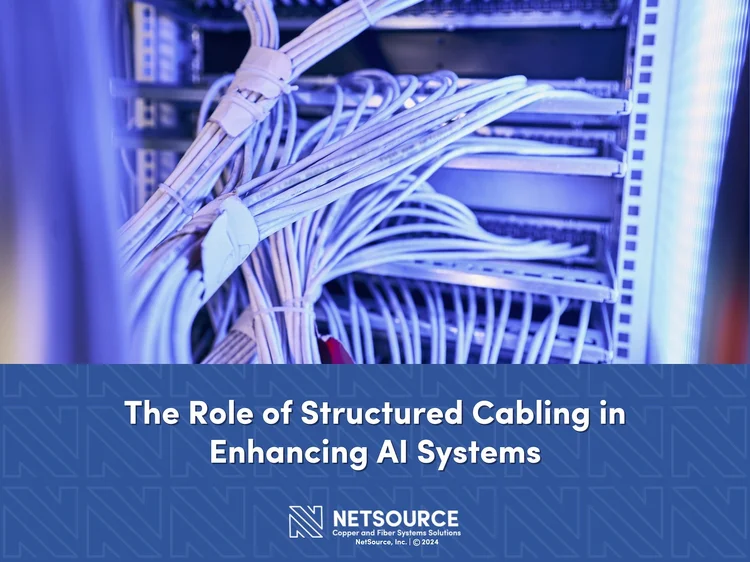
The Role of Structured Cabling in Enhancing AI Systems in the USA

The Role of Structured Cabling in Enhancing AI Systems in the USA Structured cabling forms the backbone of modern IT infrastructure crucial for ensuring data, voice, and video transmission across networks. In the era of big data and advanced computing, the role of structured cabling has become even more pivotal, especially with the increasing integration of artificial intelligence (AI) systems. The use of data cables and structured layouts ensures that AI systems can operate efficiently and scale as needed, addressing both current demands and future growth. At NetSource, we specialize in providing tailored structured cabling solutions that meet the dynamic needs of modern technologies and future expansions in the United States. This article delves into how structured cabling addresses both current needs and future expansions in the technological landscape. The Demand for High-Speed, Reliable Connections in AI | Cable Manufacturer in USA AI applications are reshaping the technological landscape, demanding ultra-fast and reliable connections to function optimally. At the core of this demand is the data center cabling infrastructure, which is important in managing the heavy data flows essential for AI operations. These systems thrive on low latency and high bandwidth—fundamental characteristics in data centers catering to AI and machine learning tasks. The rapid evolution of AI technologies requires a cabling infrastructure that supports current needs and is scalable enough to handle future needs. This necessitates investments in high-quality fiber optic solutions known for their capacity to facilitate fast data transmission over long distances without signal loss. Such robust infrastructure is vital in supporting complex AI computations and real-time data analysis across extensive networks. Types of Cables Used in AI Systems In AI infrastructure, the collaboration between fiber optic and copper cables is essential due to their distinct characteristics and capabilities, supporting different aspects of connectivity and power management. Fiber Optic Cables Fiber optic cable manufacturers in the USA are pivotal in supplying high-quality cables that meet the high-speed demands of AI systems. These cables are essential for transmitting data at lightning speeds over long distances with minimal signal loss, crucial for complex AI computations that rely on rapid, real-time data analysis and decision-making. Using light for data transmission, fiber optic cables eliminate issues like electromagnetic interference, making them ideal for sensitive data environments. Copper Cables Copper cables play a complementary role, particularly useful for power transmission and short-distance connections such as those within server racks. They handle 25G or 50G signaling over short distances of one to two meters, which is adequate for the connections between servers and top-of-rack switches in a data center architecture. Together, fiber and copper cables create a robust and efficient network infrastructure in data centers, accommodating both the extensive data bandwidth required by AI and the practicalities of power management and physical connectivity. Enhancing AI Operations With Structured Cabling Structured cabling plays a crucial role in enhancing the scalability and reliability of AI operations. This cabling framework supports efficient data flow, which is crucial for AI’s intensive computational demands. Scalability and Reliability Structured cabling systems are inherently designed to accommodate growth and changes in network architecture without major overhauls. This adaptability is essential in AI environments where data volume and processing needs can escalate rapidly. The modular nature of structured cabling allows for easy expansion and reconfiguration, ensuring that the network infrastructure can grow alongside the AI operations it supports​. Spine-and-Leaf Topologies The spine-and-leaf topology is particularly effective in data center environments involving AI tasks. This configuration minimizes latency and maximizes bandwidth, both important for the performance of AI applications. In a spine-and-leaf setup, signal cables connect leaf switches (which directly handle data to and from servers) to spine switches that route traffic across the data center. This design ensures a high degree of redundancy and fault tolerance, providing a consistent and reliable network performance necessary for AI computations. The fully meshed connections allow for very low latency and high throughput, which are essential for the rapid processing speeds required by AI systems​. Challenges and Solutions in Structured Cabling for AI Structured cabling systems face several challenges in the AI-driven data center environment. Key among these are: Data bottlenecks Power management issues The need for high-density communications cable solutions. These challenges arise as AI applications demand rapid data transmission rates and substantial power, which traditional data center cable designs struggle to provide efficiently. To address these challenges, data centers are increasingly turning to high-quality fiber optic cable management systems. These systems are crucial for mitigating data bottlenecks by providing the necessary bandwidth and reducing latency, which is critical for the real-time processing needs of AI applications. Organized and scalable cable infrastructure, including spine-and-leaf configurations, also plays a crucial role. This setup allows for greater flexibility and scalability in network cable design, effectively supporting the dynamic and intensive data flow requirements of AI operations. Empowering AI with Advanced Structured Cabling Solutions in the USA Structured cabling plays a critical role in enhancing and future-proofing AI systems. These technologies ensure robust, scalable network infrastructures crucial for AI’s demanding environments. At NetSource, we invite businesses to consult with us for tailored cable assembly solutions that meet the evolving demands of AI technologies.

Domestic Cable, Imported Cable

Domestic vs. Imported Cables: The Key Benefits of Choosing NetSource

Domestic vs. Imported Cables: The Key Benefits of Choosing NetSource When a business needs cable products in industries like broadband,  telecommunications, and wireless infrastructure, they have a decision to make. Should they buy from American cable manufacturers or go with less-expensive imports? Initially, imports may appear to be the better option due to lower prices. However, Netsource has the experience to tell you that ordering domestically is almost always the superior option. This article explains why American cable assembly manufacturers like NetSource are better positioned to help your company make those important purchasing decisions, especially for companies that need custom cable assemblies or connectivity solutions quickly. The Hidden Costs of Imported Cables It’s easy to see why some companies opt to import cables. The price is lower, and that can be tempting when a company wants to save money. However, imported cables often come with hidden costs that are not immediately apparent and can end up being more expensive in the long run. Quality Control Issues One of the main issues with imported cables is the lack of consistent quality control. Not all manufacturers overseas follow the same strict standards as American cable assembly manufacturers. This means that cables might not last as long or could fail more often. If you are working in telecommunications, for example, a failed-cable incident could cost more than what you saved by buying the cheaper cable. Delays in Shipping Another problem is shipping and delivery delays. Supply chain problems, like shipping container shortages or bad weather, often cause delays. These delays impact companies working on tight schedules. If you are waiting weeks or months for a critical cable assembly, it could derail an entire project. This frustrates teams and can also lead to extra costs for the business. There are also extra costs, such as import duties or changing exchange rates. These things can add up, making imported cables more expensive in the long run than they seem initially. Why NetSource Offers Better Value | Cable Assembly Manufacturers Netsource has 30 years of experience in this industry. We can guide you through the choice of producing your order domestically or relying on an import. You can utilize our expertise to guide your decision. In most cases we are encouraging customers to produce products with us domestically. Below we’ve outlined some of the major advantages in ordering domestically. Communication When you need a custom cable assembly that meets precise technical requirements, it is easier to convey your needs to a manufacturer who speaks the same language as you do. Communication breakdowns are common when dealing with an overseas manufacturer. The result could be costly mistakes. Quality One significant advantage is quality. Domestic manufacturers, like NetSource, follow strict regulations for quality control, ensuring their products are more reliable and longer-lasting. When you need cables and assemblies that won’t fail at a critical moment, NetSource can provide guidance on selecting the best products to meet your specific needs, ensuring you get the highest quality cable assemblies for your projects. Flexibility When you import cables you have less flexibility than if you were to produce those assemblies domestically. Example: you order 10,000 cables, all to a specification. They are put in a shipping container. Once those cables are in that container there is no changing the order. Compare that to placing your order domestically. At that point Netsource has the ability to be flexible and make changes to your order over time. It’s a collaboration. Change orders are common, and are perhaps one of the biggest advantages to ordering domestically. Faster Delivery Another advantage of choosing domestic manufacturers is faster turnaround and delivery times. Instead of waiting weeks—or even months—for an overseas order, American cable assembly manufacturers can deliver cable assemblies faster. NetSource is dedicated to customer satisfaction. We feature a quick turnaround time, usually ranging from 3 to 5 days. This can make a huge difference when working on a project with tight deadlines. Availability of Customization Customization is another area where American cable assembly manufacturers like NetSource excel. When your project requires custom cable assemblies, harsh environment cables, or military and aerospace cables with detailed specifications, purchasing from an overseas supplier will have limited oversight. When working with a domestic cable assembly manufacturer like NetSource, you can find assurance in the fact that you can see our modern, 85,000-square-foot facility and you will have the ability to see how your product is manufactured. Supporting the U.S. Economy and the Environment Netsource is proud to be an American company, and we know that many of our customers choose to produce domestically for that reason as well. We respect and appreciate you for that. The reasons to choose American cable manufacturers go beyond the product itself. When companies purchase domestically, they are helping the U.S. economy by providing local manufacturing, engineering, and product-testing jobs. According to the National Association of Manufacturers, every dollar spent on U.S. manufacturing adds $2.69 to the economy. This means that choosing American-made products will boost the economic opportunities available in the U.S., and the “Made in America” stamp is always looked upon favorably here in America. From an environmental standpoint, buying domestically helps reduce the carbon footprint. Overseas manufacturing facilities do not adhere to the same pollution-prevention standards as U.S. manufacturers. Additionally, shipping products over long distances can create a larger carbon footprint, so buying from local manufacturers minimizes this impact. For companies looking to become more environmentally friendly, choosing domestic manufacturing is one easy way to help keep our planet clean. Long-Term Savings and Reliability Although imported cables might seem cheaper upfront, the long-term savings of buying reliable cables is the smarter choice. At NetSource, we offer reliable, high-quality cable assemblies that do not break down or fail easily. Fewer failures mean fewer replacements and less downtime, saving money over time. Additionally, domestic manufacturers generally offer better customer support. If something goes wrong with your cables or cable assembly, getting a quick replacement or help from an American company is much

Scroll to Top